A cycle of three Caravaggio paintings of St Matthew may be seen for free in the Contarelli Chapel of San Luigi dei Francesi (Saint Louis of the French) church in Rome.

Three of the most famous Caravaggio paintings in Rome are in the Contarelli Chapel of the San Luigi dei Francesi church. The St Matthew cycle was Caravaggio’s first major public commission and helped establish him as one of Rome’s foremost painters in the early 17th century. The paintings are The Calling of Saint Matthew, The Inspiration of Saint Matthew, and The Martyrdom of Saint Matthew. Admission to the church is free, but some coins may be needed to feed the lights to see the Caravaggio paintings.
San Luigi dei Francesi at a Glance
- Highlights: Three Caravaggio paintings in the Contarelli Chapel
- Admission: Free
- Location: Near the Pantheon and Piazza Navona
- Opening: Closed around lunchtime; first Wednesday morning closed
- Allow: Around 20–30 minutes
- Tip: Bring coins for the chapel lights
- You can see six Caravaggio paintings in Rome for free in churches and many more in public museums.
San Luigi dei Francesi (Saint Louis of the French) in Rome
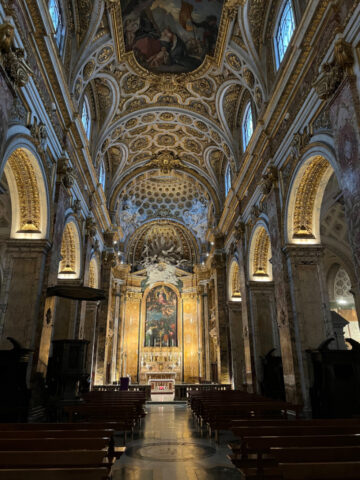
The church of San Luigi dei Francesi (Saint Louis of the French / Saint Louis des Français) is a Baroque church in the center of Rome. It is the national church in Rome of France and is named after King Louis IX — the only French king ever to become a saint in the Roman Catholic church.
The current church was begun in 1518 and completed in 1589 by Domenico Fontana to the designs of Giacomo della Porta. Catherine de’ Medici, Queen of France (1547-59), helped finance the church.
The facade of the San Luigi was designed as a purely decorative element separate from the main church — one of the first examples of a feature that would be used commonly at later churches. Statues of French heroes including Charlemagne, St Louis, and St Clothilde adorn the elegant facade.
Much of the interior is similarly a glorification of French figures, including the ceiling paintings by Charles-Joseph Natoire that depict events from the lives of St Louis, St Denis, and Clovis.
The triple-nave interior is full of golden detail. Most of the art here and inside the rows of side chapels is from the Baroque and Rococo. The Polet Chapel has fine frescoes by Domenichino, but most visitors come to see the Caravaggios.
St Matthew Paintings Cycle by Caravaggio in the Contarelli Chapel
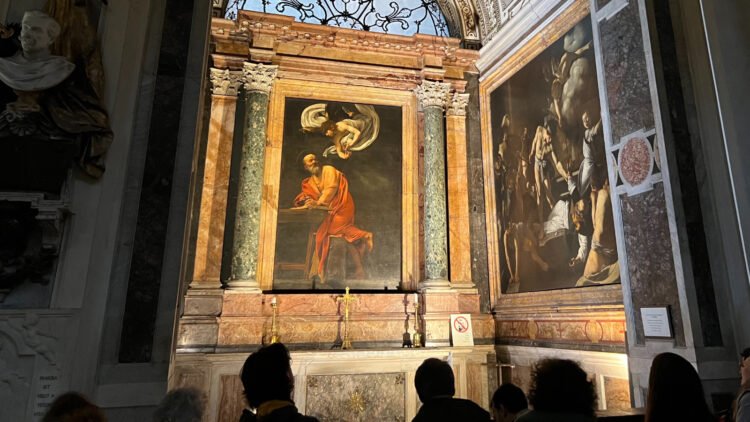
The three paintings by Michelangelo Merisi da Caravaggio (1571-1610) depicting scenes from the life of St Matthew are by far the most famous works in Saint Louis of the French and the main reason to visit this church near the Pantheon (no longer free!).
In 1599, Caravaggio, an established but not yet famous painter, received the commission for two large paintings on the life of St Matthew for the Contarelli Chapel. The furnishing of the chapel was financed by a French cardinal, Matthieu Cointerel (Matteo Contarelli in Italian), who left precise instructions in his will that the chapel be decorated with art depicting events in the life of his namesake apostle.
Caravaggio was not the first choice, but the two paintings he delivered — his first major public commissions and first large-scale religious narrative paintings — established him as one of the foremost artists in Rome at the time (and today among the most celebrated painters of the Baroque). He was commissioned to paint the third work only after a marble statue of Matthew was rejected.
Caravaggio: The Calling of Saint Matthew in San Luigi dei Francesi
.jpg)
The Calling of Saint Matthew (Vocazione di San Matteo, 1599-1600) by Caravaggio in the Contarelli Chapel in San Luigi dei Francesi in Rome is one of the finest Baroque masterpieces ever painted. It is a large oil on canvas painting, measuring 322 x 340 cm (127 x 130 in), placed on the left wall of the chapel. Caravaggio cleverly took into account that visitors have to see the painting from the side, as most are not allowed to enter the private chapel, and that the only source of natural light is from the top right-hand side.

In The Calling of Saint Matthew, Caravaggio painted, as commissioned, the moment Jesus called Matthew, a tax collector, to give up his business and follow him. Jesus and Peter are on the right, standing, with Jesus pointing at Matthew with a hand similar to Adam’s in the Sistine Chapel.
This action interrupts the five money counters seated around a table. The three younger ones wear colorful clothing in the contemporary fashion of Caravaggio’s time. It is generally accepted that the bearded man pointing “me?” is Matthew. However, some speculate that the bearded man points at Matthew, the young man who is not even looking up from counting money.
Cardinal Contarelli’s will specified that Matthew should be presented in a way that shows his desire to follow Christ. Caravaggio ignored the latter: if Matthew is the older man with a beard, he is more confused and surprised. If he is the youth, he has not even acknowledged (or noticed) the calling from Christ.
Caravaggio: The Martyrdom of Saint Matthew in San Luigi dei Francesi
.jpg)
The Martyrdom of Saint Matthew (Martirio di San Matteo, 1599–1600) by Caravaggio hangs on the right side wall of the Contarelli Chapel in Saint Louis of the French Church in Rome. X-ray studies showed that Caravaggio struggled and changed the composition several times before settling for the final version. This large painting is the same size as The Calling of St Matthew directly opposite it.
According to tradition, St Matthew was murdered while celebrating Mass. His assassin was sent by the King of Ethiopia, after Matthew had rebuked the king for lusting after his own niece.
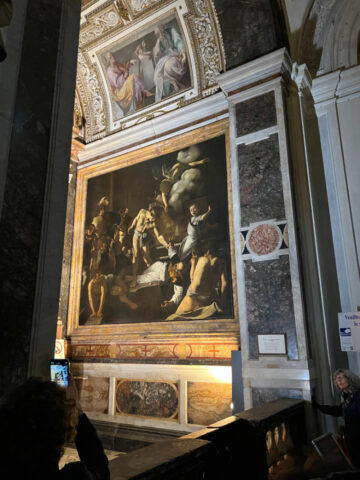
Caravaggio painted the moment before St Matthew is slain. An elderly Matthew is pushed onto his back in front of the altar, while the assassin’s sword is drawn and ready for the kill.
Matthew’s reaction is impossible to read. He does not seem to entirely welcome martyrdom, as was requested in the will of Contarelli. He shows no fear, but it is unclear whether he is trying to fend off the attacker or rather reaching for the palm leaf of martyrdom being handed down by an angel, whose apparition is not visible to the others present.
Chaos and confusion reign. The altar boy screams. Some men are trying to get away as fast as possible, including Caravaggio’s self-portrait at the center behind the assassin.
The almost-naked men are probably neophytes wearing only loincloths in preparation for baptism. The assassin possibly joined this group to get closer to Matthew. However, the presence of well-dressed men, similar to the youths in The Calling, showed that was hardly necessary. Hiding a sword is certainly easier under a coat than when dressed only in a loincloth.
Naked flesh usually worked well for Caravaggio. When approaching the chapel, visitors see the semi-nude assassin long before being able to work out the rest of the scene, or even noticing Matthew on his back.
Caravaggio also used the nakedness of the assassin to contrast the barbarism of the savage heathen with the saintly and holy white robes of the saint. Not only Matthew but the Eucharist and, by extension, the whole Catholic Church is under attack.
Caravaggio’s Conversion of St Paul in the Santa Maria del Popolo church in Rome has an equally dramatic composition.
Caravaggio: The Inspiration of Saint Matthew in San Luigi dei Francesi
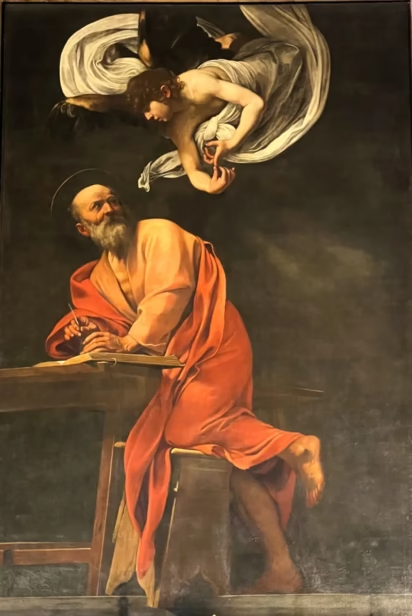
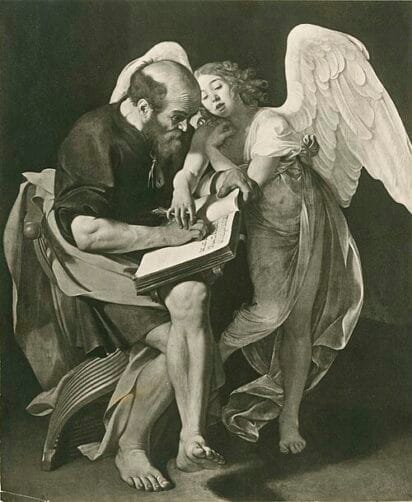
Caravaggio’s first version, Saint Matthew and the Angel (1602), was also rejected (or possibly was only a temporary loan, as among other things it was the wrong size for the space). This painting, which was most likely destroyed by fire in Berlin at the end of the Second World War, showed an elderly St Matthew with dirty bare feet. (A favorite Caravaggio theme repeated in the Madonna of Loreto in the nearby Sant’Agostino church.) In this painting, Matthew’s hand was guided in writing the Gospel by a somewhat bored angel standing next to him in an almost erotic pose. (Caravaggio painted the even more erotic Amor Victorious in the same period — now the pride of the Italian collection in the Gemäldegalerie in Berlin).
In the final large oil on canvas (292 x 186 cm / 115 x 73 in), The Inspiration of Saint Matthew, Caravaggio painted St Matthew still with bare feet but now washed, writing the Gospel at his desk. Rather than having his hand physically guided by an angel, the angel flies above him and seems to be reminding him only of a few pertinent points or details of events. The painting is on the whole a very successful contrast between light and dark.
Visit San Luigi dei Francesi in Rome

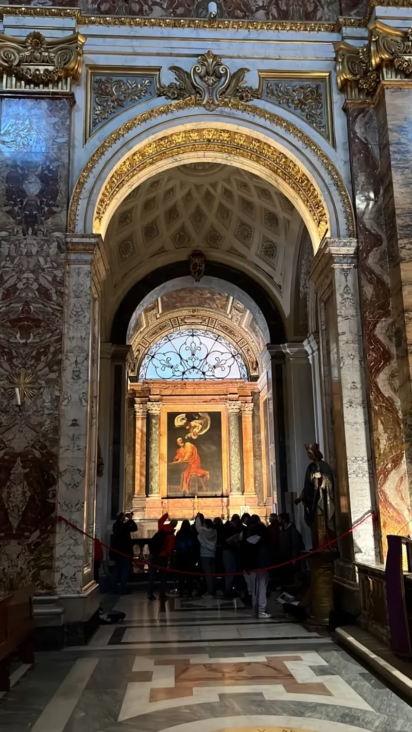
The Church of San Luigi in Rome is open:
- Weekdays: 9:30 to 12:45 and 14:30 to 18:15
- Saturdays: 9:30 to 12:00 and 14:30 to 18:30
- Sundays: 12:00 to 12:45 and 14:30 to 18:30
The church is closed on the morning of the first Wednesday of each month, and opening hours may change for religious services or special events.
In contrast to so many other churches in Rome, the website of Saint Louis of the French actually has up-to-date information and a free audio guide.
Admission is free, but a few coins may be needed for the lights of the Cantarelli Chapel to see the Caravaggio paintings.
Although every French school group visiting Rome is guided through this church, groups tend to move on quickly (and teachers feed the lights while giving free descriptions of the works in French).
San Luigi dei Francesi church in Rome is on the Piazza San Luigi de’ Francesi, just a few blocks from the Pantheon (which is no longer free) and Sant’Agostino (with a further Caravaggio masterpiece).
→ See also Where to See Caravaggio Paintings in Rome for more on the 26 Caravaggios in the eternal city. Six are in churches and most of the rest in museums, including six in the Borghese Gallery.