The Gemäldegalerie in Berlin is one of Europe’s great Old Masters art museums, with masterpieces by Caravaggio, Rembrandt, Vermeer, Cranach, Dürer, Botticelli, Raphael, and Titian.

The Gemäldegalerie in Berlin is one of the best art museums in the world. The gallery covers European paintings from the 13th to the late 18th century, with well over a thousand Old Masters’ works on display. The collection is particularly strong on early German and Dutch paintings, Italian Renaissance paintings, and 17th-century Dutch and Flemish paintings. It famously has 17 Rembrandts, two Vermeers, a scandalous cupid by Caravaggio, and a superb collection of Italian Renaissance works. Buy Gemäldegalerie tickets online to skip the line and enter the gallery directly.
Gemäldegalerie in Berlin: Quick Guide
📍 Location: Kulturforum, Berlin
⭐ Don’t Miss:
- Caravaggio, Rembrandt, Vermeer, Cranach, Dürer, Holbein, Van Eyck, Botticelli, Raphael, Titian, Rubens.
⏱ Time Needed:
At least an hour for top highlights, average visits last two to three hours
🎟 Best Ticket:
Kulturforum Day Ticket if visiting more than one museum.
📅 Best Time to Visit:
Weekdays at 10:00 or after 15:00
📷 Photography:
No-flash photography is allowed and actively encouraged.
🎨 Good For:
Old Masters paintings — one of the world’s top art collections.
Why Visit? Berlin’s best museum for Old Masters paintings, including Caravaggio’s Cupid as Victor, two by Vermeer, many by Rembrandt, Cranach, Dürer, Holbein, and Rubens.
The Gemäldegalerie is one of the top art museums to visit in Berlin. It is generally less crowded than the nearby Neue Nationalgalerie (20th-century art), but this collection of Old Masters paintings is one of the finest in the world. The top highlights can be seen in a rushed (and disciplined) hour, but it is absolutely worth spending two to three hours in this art museum. It is not the size of the Louvre, but museum fatigue will set in long before you run out of paintings.
Jump to:
Top 10 · Collections · Highlights · Tips · Tickets · Hours
Gemäldegalerie Art Museum in Berlin

The name Gemäldegalerie is deceptively simple — it means “paintings gallery”. Add “in Berlin” and art lovers’ eyes sparkle: this is one of the finest collections of European Old Masters paintings in the world.
The Gemäldegalerie is home to the Berlin State Museums’ collection of European paintings from the 13th century to around 1800. Around 1,300 paintings are on permanent display, but the full collection includes some 3,500 paintings and 3,000 historic frames. Despite these impressive numbers, it is the quality rather than the quantity that makes the museum special.
The paintings were systematically acquired with art-historical development and quality in mind. The collection is particularly strong in Italian art from the 13th to 17th centuries, early German masters, and Dutch and Flemish paintings. The Dutch collection, especially works from the 15th to 17th centuries, is among the finest in the world.
French, Spanish, and English works are also represented, although generally in smaller numbers and not at quite the same level as the Italian, Dutch, Flemish, and German paintings. Even so, the English collection is the most comprehensive in Germany.
Top Ten Artists and Paintings in the Gemäldegalerie in Berlin
- Caravaggio — Amor Victorious / Cupid as Victor / Omnia vincit amor
- Rembrandt — Self-portrait, Moses with the Tablets of the Law, and other works
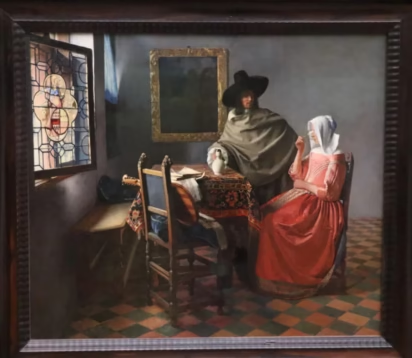
- Vermeer — The Glass of Wine and Woman with a Pearl Necklace
- Cranach — The Fountain of Youth, Venus and Amor, and others
- Botticelli — Venus, The Virgin and Child with Singing Angels
- Jan van Eyck — Madonna in the Church
- Titian — Venus with an Organist
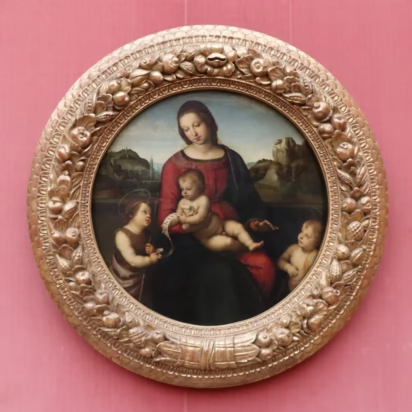
- Raphael — Madonna and Child (five versions)
- Dürer — Hieronymus Holzschuher
- Holbein — The Merchant George Gisze

For more details on the most famous paintings in the Gemäldegalerie in Berlin:
Permanent Exhibitions in the Gemäldegalerie in Berlin
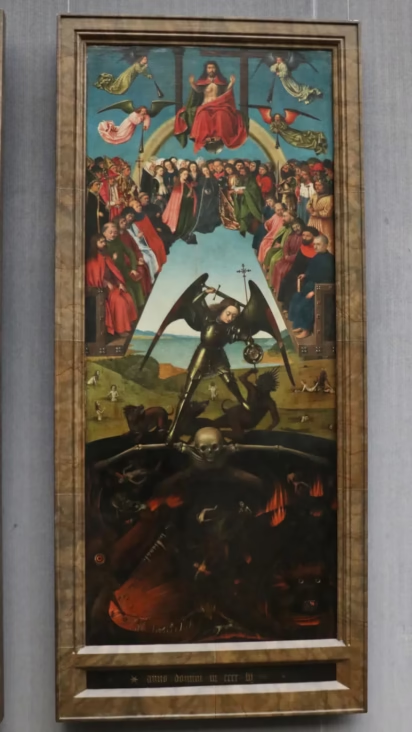
The permanent collection is displayed in 18 main halls and around 40 smaller cabinets. Do not skip the cabinets — some of the finest works in the Gemäldegalerie are shown in these smaller rooms.
Following the museum’s hall numbering system, the Gemäldegalerie collection is broadly divided into:
- German paintings from the 13th to 16th centuries
- Netherlandish paintings from the 13th to 16th centuries
- Flemish and Dutch paintings from the 17th century
- English and German paintings from the 18th century
- Italian, French, and Spanish paintings from the 17th and 18th centuries
- Italian Paintings of the 16th century
- Italian paintings of the 13th to 15th centuries
Seeing the gallery in the reverse order is also popular, especially for visitors who want to start with the Italian Renaissance paintings rather than arrive there tired at the end of a long visit. A one-way system is at times necessary and usually guides visitors to the German old masters first.
Other major art museums in Berlin include the Bode Museum (13th to 18th-century sculptures) and the Alte Nationalgalerie (19th-century art) on Museum Island; the Neue Nationalgalerie (modern art up to 1970) in Kulturforum; and the Hamburger Bahnhof (contemporary art).
Strategies and Tips for Visiting the Gemäldegalerie

The Gemäldegalerie is deceptively big. Simply walking through the museum is a 2 km hike (well over a mile). Spending ten seconds with each work on display in the Gemäldegalerie will stretch a visit to well over three hours.
No one could manage to see all the paintings in a single visit, making it a good strategy to visit again (and again, it is always worth it). Expect to be too exhausted to fully appreciate the last sections visited.
On a first visit, concentrate on the main works. These are scattered throughout the museum, but the free audioguide gives at least a strong indication of which works the museum curators consider the most significant.
In addition to the absolute highlights, it may be sensible to concentrate only on a smaller section of the museum, or even only a few rooms. The details in some paintings are incredible and only revealed when studied closely.

Download or at least study the museum floor plan map (PDF) before visiting. Two of the museum highlights are about as far from the entrance as you can get: the Vermeers in room 18 and the Rembrandts in Hall X. If exiting through the Italian Renaissance and Baroque sections, remember to turn around in Hall XIV — Caravaggio’s Cupid as Victor will be behind you
Visiting only the main halls (with Roman numerals) might seem a good idea, but it is a false strategy — some of the top works are on display in the cabinets (smaller rooms with regular Arabic numbers). This is especially the case in the German and Dutch sections, where excellent works are often in a smaller format, as they were painted for the homes rather than the palaces of the rich.
The permanent collection of the Gemäldegalerie may usually be visited without paying the surcharge for special temporary exhibitions in the central hall.
Descriptions of Top Paintings in the Gemäldegalerie in Berlin
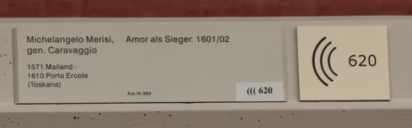
The descriptions in the museum are mostly in German only, but are often so cryptic (painter, date, name of work) that it hardly matters. The free audio guide is a great help, but there are always some works not covered that certainly have good stories to tell too. The museum shop has excellent guidebooks, but many works are well described online too. (The museum offers free wifi.)
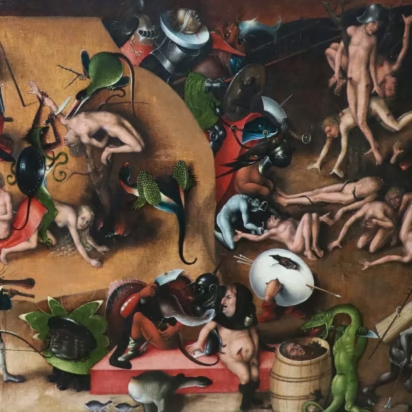
The Berlin State Museums have a wonderful digital online collections database of many of its works. Searches are possible in English, with English descriptions of works often following after the German. For the Gemäldegalerie, 70 works are currently described in the highlights section and around 1500 in the “all objects” option.
The catalog could help in advance in deciding which works to see, or inside the museum to read up on the details of the paintings and the painters. If inside the museum, simply search with the catalog number (Kat. Nr.) on the name tags.
- Gemäldegalerie: 200 Masterpieces of European Painting is a beautiful book (available in the bookshop but pricy and heavy – 5.7 pounds or 2.5 kg!). Much of the information in the book is available for free when searching the Gemäldegalerie’s online catalog.
Highlights of the Gemäldegalerie in Berlin

Absolute highlights of the Gemäldegalerie in Berlin include:
- 17 paintings by Rembrandt and several more by his workshop and influence circle.
- 2 paintings by Johannes Vermeer.
- Caravaggio’s Amor Victorious — the most scandalous and possibly best-known painting in the Gemäldegalerie.
- Works by all the German Old Masters, including multiple paintings by Lucas Cranach (22), Albrecht Dürer (7), and Hans Holbein (2 by The Elder and 5 by The Younger).
- Works by Dutch and Flemish masters, including various by Pieter Brueghel (2), Jan Van Eyck (3), Petrus Christus (4), Rogier van der Weyden (3 altars and other works), Anton van Dyck (7), Rubens (7), Frans Hals, Jan Steen, Jan Van Goyen, and the extended Brueghel family.
- Works by Italian Renaissance and Baroque artists as diverse as Giotto, Botticelli, Raffael, Titian (Tizian), Caravaggio, and Canaletto.
Visitors starting at the Old German painters will be exhausted when exiting via the Italian early Renaissance, and vice versa.
→ See also Highlights of the Gemäldegalerie and the Italian Collections for more photos and descriptions of favorite paintings.
Visit Temporary Exhibitions in the Gemäldegalerie in Berlin

The Gemäldegalerie website has a special section “Collection on Tour” — this is not a traveling exhibition arranged by the museum but rather a list of the major works currently on loan to other galleries. An art museum that simultaneously lends out works by Botticelli, Vermeer, Rembrandt, Titian, Holbein, and Dürer to museums all over the world, not only clearly has a major collection but could borrow similar works in return.
There are no half-measures when the Gemäldegalerie stages temporary exhibitions. Special exhibitions are usually held in the central hall (Wandelhalle) — a very large space in the center of the museum. Surcharges and separate time-slot reservations often apply for temporary exhibitions, but the vast permanent collection may usually be seen as usual.
→ See Special Exhibitions in the Kulturforum for more information on planned temporary exhibitions.
Visitor Information for the Gemäldegalerie in Berlin

Opening Hours of the Gemäldegalerie
The Gemäldegalerie in Berlin is open Tuesday to Sunday from 10:00 to 18:00. Closed on Mondays.
The art museum is open on public holidays, including on Mondays, but closed on December 24 and 31.
In contrast to the nearby Neue Nationalgalerie, the Gemäldegalerie is not currently open on Thursday evenings.
Tickets for the Gemäldegalerie
Ticket prices for the Gemäldegalerie are €14 — sometimes a surcharge is added for major exhibitions. Time-slot reservations are not currently in use (but are sometimes needed during busy times or for major exhibitions).
For most visitors, buying a Gemäldegalerie ticket online is the easiest option and avoids ticket office queues. If planning to visit another venue on the same day, the Kulturforum Day Ticket is a good savings option. With a scanable ticket, pick up the free audio guide and proceed directly to the museum entrance.
Admission is free for under-18-year-olds and bearers of the superb-value 3-day Museum Pass Berlin.
Why the Kulturforum Day Ticket Is Good Value
The €22 Kulturforum day ticket is cheaper than visiting two museums individually and gives access to Berlin’s best art collections:
- Gemäldegalerie — one of the world’s greatest collections of old master paintings.
- Neue Nationalgalerie — 20th-century art displayed in a Mies van der Rohe masterpiece.
- Kunstgewerbemuseum — decorative arts and design.
- Special exhibitions by the Museum of Prints and Drawings and the Art Library.
- Musical Instruments — 800 historic instruments; try visiting when the Mighty Wurlitzer theater organ is played.
Most visitors easily see two museums in a day, making the pass good value.
Transportation to Visit the Gemäldegalerie in Berlin
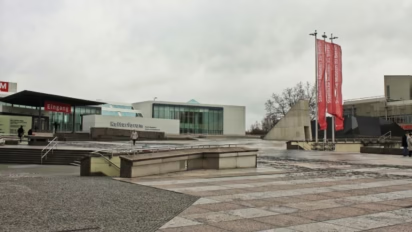
The Gemäldegalerie is at the heart of the Kulturforum, near the Sony Center and Potsdamer Platz, south of Tiergarten in central Berlin.
The closest bus stop is Philharmonie / Philharmonie-Süd (buses 200, 300, M41), while Kulturforum (buses M48 & M85) and Potsdamer Brücke (M29) are also convenient on major bus lines.
The closest U-Bahn and S-Bahn station is Potsdamer Platz — from here, take any of the buses listed above, or simply walk. (The FEX Berlin Airport Express trains now also stop at Potsdamer Platz four times per hour.)
The main Kulturforum building was only completed in 1998. The area is a bit drab and grey on the outside, but a great space for exhibiting art (in contrast to the nearby Neue Nationalgalerie, designed by Mies van der Rohe). The construction between the Gemäldegalerie, Neue Nationalgalerie, and the Philharmonie is for the new Berlin Modern, which will display 20th-century art (likely to open in the early 2030s).
→ See also: Highlights in the Gemäldegalerie (German, Dutch, Flemish, French, English, Spanish) and the Italian Renaissance and Baroque Collections in the Paintings Gallery for some of the most popular works in the museum.
Gemäldegalerie: 200 Masterpieces of European Painting is a beautiful book (but heavy and pricy) — much of the information in the book is available for free when searching the online catalog of the Gemäldegalerie.
More on the Berlin State Museums (Staatliche Museen zu Berlin):
Berlin State Museum Basics:
- Top National Museums and Galleries (brief overview)
- Berlin State Museums: What Is Seen Where?
- Opening Hours (2026)
- News & Special Exhibitions
- Ticket Prices (Buy online from GetYourGuide or SMB)
- Save with the Berlin Museum Pass & Berlin Welcome Cards
- Staatliche Museen zu Berlin (official website in German & English)