Visit the free Museum of Modern Art (Musée d’Art Moderne de Paris) at the Palais de Tokyo to see modern 20th-century and contemporary art.
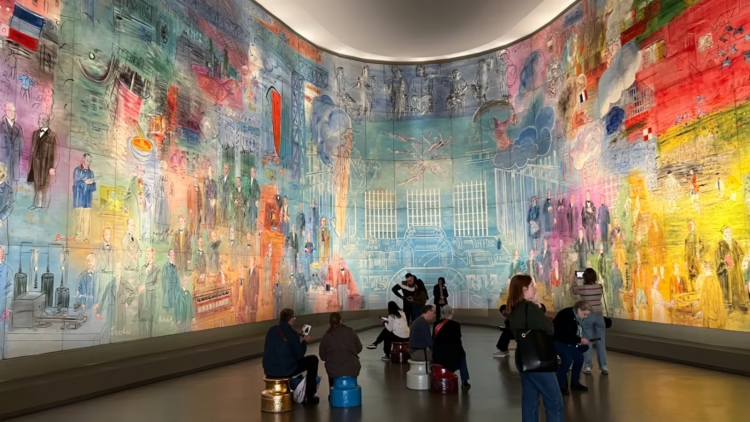
The Musée d’Art Moderne displays the 20th-century modern art collection of Paris in the mid-1930s Palais de Tokyo. Highlights include two large murals by Henri Matisse and a massive fresco celebrating the wonders of electricity by Raoul Dufy. Admission to the permanent collection is free without time-slot reservation tickets. This municipal gallery covers the same period as the more famous Pompidou national museum (closed until the 2030s).
Museum of Modern Art (Musée d’Art Moderne de Paris)

The Museum of Modern Art (Musée d’Art Moderne de Paris) displays much of Paris’s vast collection of 20th-century art. The permanent collection, which is usually free and seen without tickets or time slot reservations, covers all periods from Fauvism to contemporary art. The pre-1940s collection is particularly interesting.
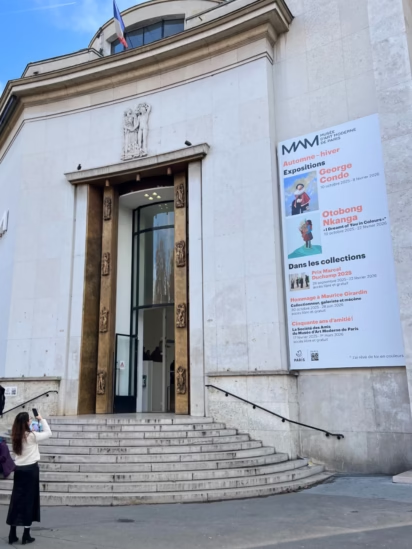
The Modern Art Museum uses half of the Palais de Tokyo — a beautiful Art Deco building, erected for the Exposition Internationale des Arts et des Techniques in Paris in 1937. The building itself, including the Art Deco metopes and bronze doors, is worth seeing too and is accessible for free.
The other half of the building is a national gallery and claims to be “Europe’s largest center for contemporary creation”. It often refers to itself simply as the Palais de Tokyo. (The name came from the previous street address rather than the Japanese capital city.)
The two upper floors of the Modern Art Museum are used for temporary exhibitions (admission charged). The main lower floor (free) has the permanent displays of modern and contemporary art.
Highlights of the Musée d’Art Moderne de Paris
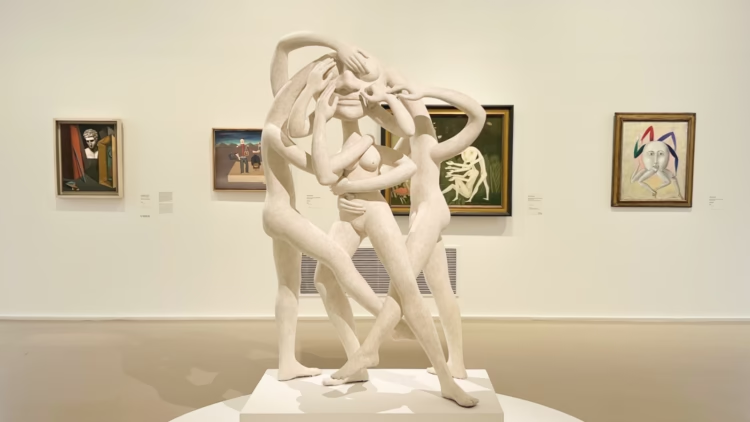
Two of the highlights in the museum are part of the permanent collection and are thus seen for free. These are in two dedicated, smaller halls and are commonly seen first due to the locations near the entrance on the museum’s fifth and third levels: the Salle Raoul Dufy and the Salle Henri Matisse.

Salle Raoul Dufy
The Raoul Dufy Room is a top attraction of the permanent collection of the Museum of Modern Art in Paris. It beautifully displays a single work: Raoul Dufy’s huge La Fée Électricité (The Spirit of Electricity, 1937).
An electricity company contracted Raoul Dufy(1877-1953) to create this 60-meter-long curved fresco for the 1937 International Exhibition “to highlight the role of electricity in national life and in particular to show the leading social role played by electric light.” Dufy worked on 250 plywood panels, each around 6½ by 4 feet (2 by 1.2 m) and used nearly 1,100 pounds (500 kg) of paint to produce a monumental work spanning more than 6,450 square feet (600-m2).
Chronology of La Fée Électricité
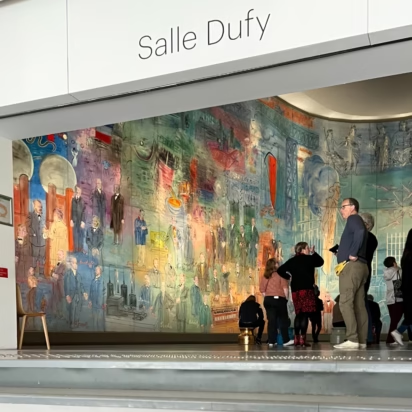
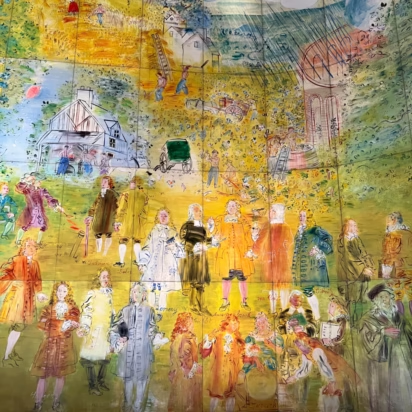
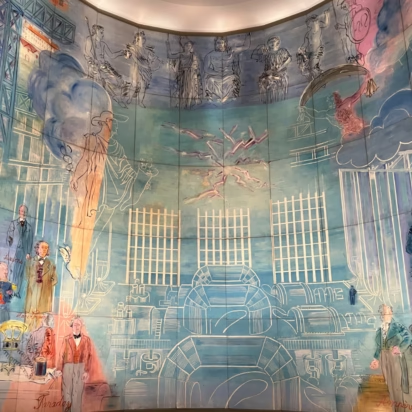
The basic chronology of the painting is from right to left. It started with the beginning of the world and antiquity, showing some slow progress in agriculture and early industrialization. The sun is the source of light for this half of the work.
At the center of the painting (the predominantly blue area), Hermes brings electricity from the Olympic gods down to humanity. Real industrialization and progress follow.

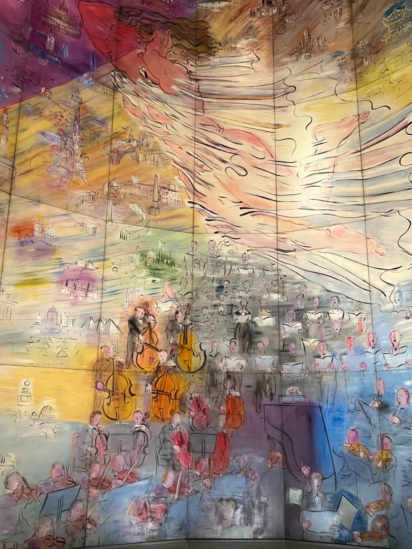
The second half of the painting is lit by electricity. Dufy balances the gift from the gods somewhat by painting 108 scientists (and many artists) associated with the development and use of electricity.
Iris, the fairy (La Fée) after whom the painting was later named, appears to the far left. Goddess of the rainbow, Iris brings the world to life: she lit up around 50 capital cities in the painting. Clearly, electricity is modern; electricity is fun.
La Fée Électricité, a name established long after Dufy’s death, was donated to the museum in 1964 and displayed somewhat modified in this special oval room. The current seats, Points d’observation, 2019-2020, by Johan Creten, invite visitors to linger longer. Download the free virtual guide to decipher the images.
The Salle Raoul Dufy is on level 5, a flight of stairs up next to the cloak room and toilets.
Salle Henri Matisse

The Henri Matisse room is used for the display of two large versions of La Danse (The Dance) by Henri Matisse: La Danse inachevée (Unfinished Dance, 1931) and La Danse de Paris, 1933. These mural triptychs were produced in preparation for La Danse at Merion (also La Dance II), which was commissioned by the Barnes Foundation in Pennsylvania, USA.
La Danse inachevée
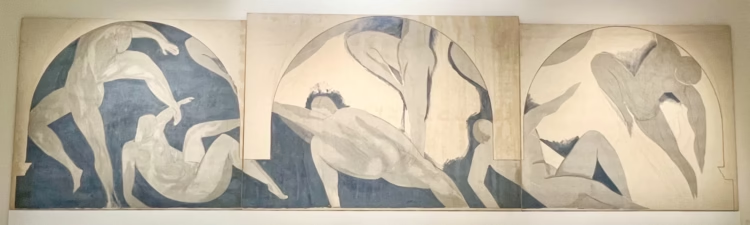
Matisse started work on La Danse inachevée in 1931. He drew the eight figures using charcoal attached to a long bamboo. The figures were then painted in grey on a blue background. However, he realized that the size of the work — ca. 355 by 1270 cm (roughly 12 × 42 feet) — would require too much rehandling.
He abandoned this version and used the unfinished work as a pinboard for paper cutouts for a simpler design, which would eventually become La Danse de Paris. La Dance inachevée was rolled up and forgotten until a chance discovery in 1992.
A measuring error forced Matisse to start yet another version. This one, La Dance de Merion, was completed in April 1933 and installed by Matisse at the Barnes Foundation in Merion, Pennsylvania, USA. It is also sometimes known as La Dance II.
La Danse de Paris

Back in France, Matisse returned to the earlier version. He rearranged the figures and reduced the dancers to six on a background of blue and pink panels. The final La Danse de Paris, 1933, has been on display in the Modern Art Museum since 1937.

Facing La Danse inachevée is Daniel Buren’s (1938- ) Mur de peintures — an ensemble of 20 paintings of vertical stripes created between 1966 and 1977 and displayed in this format since 1995.
The Salle Henri Matisse is on level 3, a flight of stairs lower than the main entrance (and near the exit). It is sensibly seen on the way to the main floor.
MAM’s Collection Galleries

The free permanent collection of the museum is on level 2 in a large Modern Art section, and a smaller number of rooms with contemporary art displays.
Although not exclusively French, many of the artists had a strong connection to Paris. The city of Paris commissioned many works, while some are donations by Parisians.
The Museum of Modern Art has paintings and sculptures by almost all the famous artists from the 20th century. However, in contrast to the Orsay or Louvre, it does not have specific must-see works. It is a pleasure to simply stroll through and enjoy the works on their own merit, without having to hunt down the Mona Lisa or Le Déjeuner sur l’herbe. (If you need a tour or guide, download the free museum app with highlight tours ranging from half an hour or family tours of 90 minutes.)
Colorful Paintings

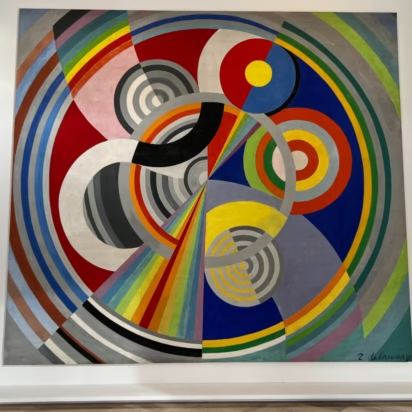
A quote by Henri Matisse seems to sum up the choices for the pre-war selection of works:
«La couleur surtout et peut être plus encore que le dessin est une libération. » (“Above all else and perhaps even more than drawing, colour is a liberation.”)
Colorful paintings from the first half of the 20th century include several works by Robert Delaunay (1885-1941), Sonia Delaunay Terk (1885-1979), Pierre Bonnard (1867-1947), Raoul Dufy (1877-1953), Fernand Léger (1881-1955), Andre Derain, Georges Braque, and Picasso, who is best represented in Paris at the Picasso Museum.
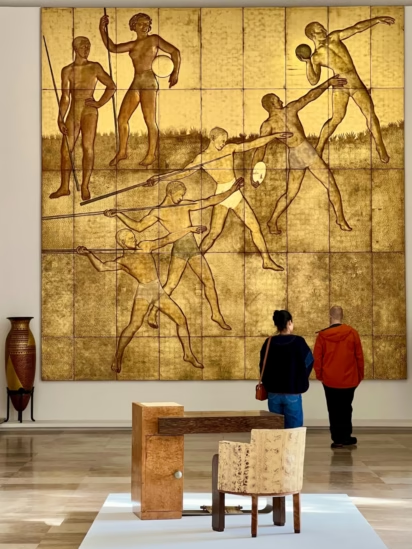
The small but impressive Art Deco display includes Les Sports (The Sports), 1935, by Jean Dunand (1877-1942) — a set of monumental decorative panels inspired by the Olympic Games.
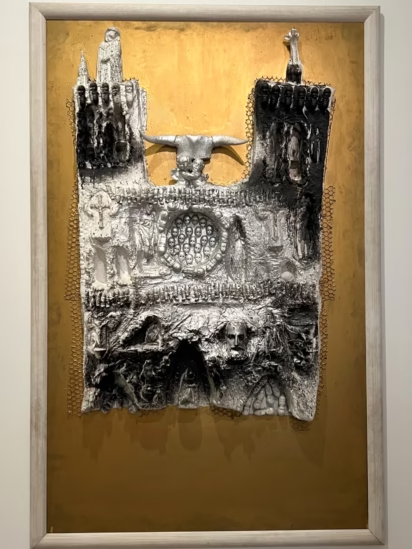
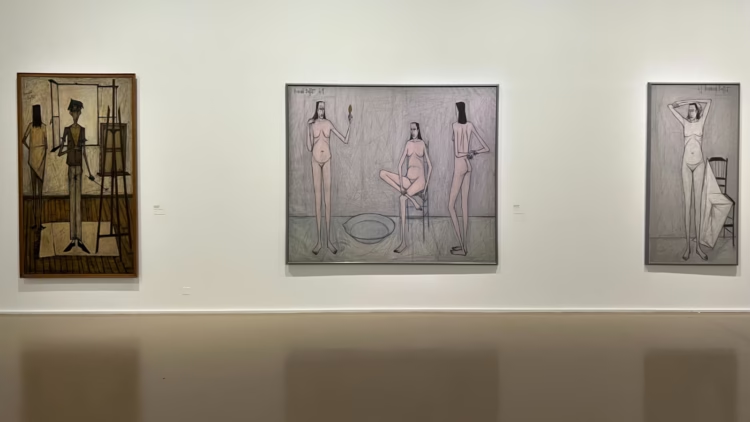
Post-war works are often less colorful with straighter lines. Even Notre-Dame de Paris, 1962, by Niki de Saint Phalle (1930-2002), is far from the brightly colored works she is famous for, such as the Stravinsky Fountain outside the Pompidou. Several of the museum’s 22 paintings by Bernard Buffet (1928-1999) are usually on display.
A Few Sculptures
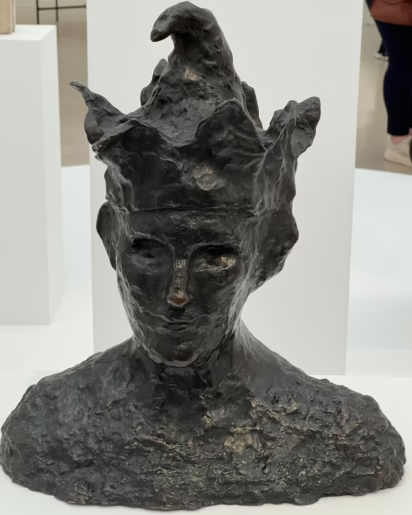
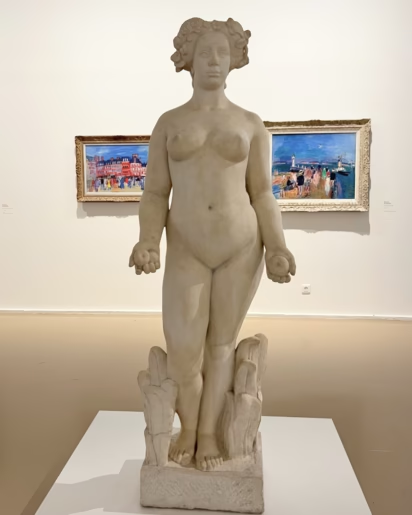
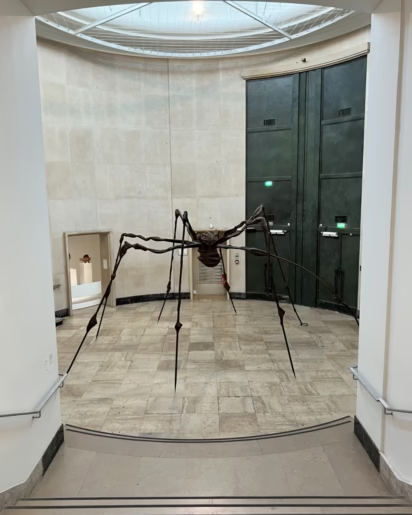
A few sculptures include Le Fou, 1905, by Pablo Picasso (1881-1973); Pomone, 1937, by Aristide Maillol (1861-1944); Congloméros, 1945, by Victor Brauner (1903-1966), and a large Spider (Araignée), 1995, by Louise Bourgeois (1911-2010).
The contemporary art exhibitions seem to change more frequently and include many playful, fun works. Only a few rooms are used for the latest art, while the Palais de Tokyo across the courtyard is, of course, the venue for contemporary art in Paris.
Where to See Top Art in Paris

Paris has some of the world’s most important and most popular art museums. The top three are:
- The Louvre — the world’s largest art museem with art from early history to the early 19th century.
- The Musée d’Orsay displays 19th-century art, including the world’s largest collection of Impressionist paintings.
- The Pompidou, closed until the early 1930s, is France’s national museum of modern art. It covers in a grander scale the same period as the municipal Musée d’Art Moderne, which displays the 20th-century art of the city of Paris. The adjacent Palais de Tokyo is a national gallery and claims to be “Europe’s largest center for contemporary creation”.

The famous museums are of course absolutely worth seeing but they get very busy. Visiting smaller Parisian museums with top displays and often smaller crowds are often far more pleasant to visit:
- The delightful Cluny Museum has art from the Middle Ages.
- The Marmottan Museum owns the world’s largest collection of Monet paintings, including Impression, Sunrise.
- The Orangerie is home to the largest water lily paintings.
- Single-artist museums with impressive collections include Picasso, Rodin, and Bourdelle (free).
- For something completely different, visit the fun Museum of Fairground Arts in Bercy.
The Paris Museum Pass is a good money-saving deal if visiting many museums for short visits. If planning to spend the whole day in the Louvre or several hours in the Orsay, single tickets may be a better option.
Visitor Information: Paris Museum of Modern Art
Opening Hours Tickets
The opening hours of the permanent collections (free) of the Musée d’Art Moderne de Paris are:
- 10:00 to 18:00 from Tuesday to Sunday
The temporary exhibitions (charge) are additionally open until 21:30 on most Thursdays.
The museum is closed on Mondays, 1 January, 1 May, and 25 December.
Tickets and Reservations
Admission to see the permanent collections of the Museum of Modern Art (Musée d’Art Moderne de Paris) at the Palais de Tokyo is free. Time-slot reservations are usually not possible.
Many of the temporary exhibitions are charged for and require time slot reservations. Tickets can be surprisingly expensive, but the displays are generally of good quality.
Separate tickets are required for the contemporary art in the Palais de Tokyo.
Transportation to the Museum of Modern Art in Paris
The Museum of Modern Art (Musée d’Art Moderne de Paris), 11 Avenue du Président Wilson 75116 Paris, is in the eastern half of the Palais de Tokyo in central Paris (right if approaching from the Seine River).
The closest metro stations are Alma-Marceau and Iéna on line 9. The Musée Marmottan Monet is also on line 9, near La Muette station.
It is also a pleasant walk from other major sights, including the Eiffel Tower, Pont Alexandre III, Invalides (Napoleon’s Tomb), and the Petit Palais. The Palais Galliera, across the street from the main entrance, also has contemporary art exhibitions and a pleasant (free) garden worth exploring.