The KZ-Gedenkstätte Dachau preserves the site of the first concentration camp established by the Nazi regime in 1933. Today, it is one of Germany’s most important memorials to the victims of National Socialism.
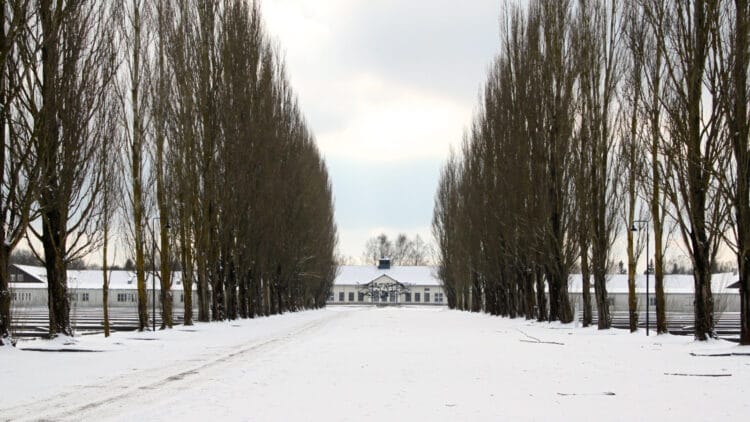
KZ Dachau, the first concentration camp opened by the Nazis in 1933, is now a memorial center for victims of National Socialism. Between March 22, 1933, and liberation by the US Army on April 29, 1945, well over 200,000 people moved through Dachau (and many more through subsidiary camps) with 32,000 recorded deaths. Visiting the KZ-Gedenkstätte is very interesting but emotionally draining – it is not recommended for children. Guided tours are available from Munich or a few times per day from the information center. Transportation from Munich to Dachau by train and bus takes around 40 minutes. The memorial is open daily and entry is always free.
Dachau Concentration Camp Memorial: Quick Guide
📍 Location: Dachau, 40 minutes from Munich
📖 Key Places to See:
- Original concentration camp grounds
- Jourhaus and “Arbeit Macht Frei” gate
- Excellent permanent exhibition.
- Note: Historical exhibits include graphic photographs and original documentation.
⏱ Time Needed:
2-3 hours at the memorial site
🎟 Best Ticket:
Admission is always free
📅 Best Time to Visit:
Open daily except December 24. Early morning is usually the quietest time to visit.
✅ Open on Mondays.
👨👩👧👦 Good For:
Best suited to adults and older teenagers. Not recommended for children under 12 because of graphic historical photographs and exhibits.
Why Visit? Historical site of enormous importance. The first concentration camp opened by the Nazi is now a large memorial site with an excellent museum. Easy to reach from Munich on a half-day trip by train or guided tours.
Visit Dachau Concentration Camp Memorial near Munich
The modern Visitors Center, right at the KZ-Gedenkstätte bus stop and the main entrance to the Dachau memorial complex, is a good first stop for picking up a site map or buying a more comprehensive visitor’s guide. Audio guides are available here, while the bookshop has a large range of books in German, English, and other languages.
Official guided tours take around 2.5 hours — currently, reservations are not possible. It is good value at only €4. English tours are usually at 11:00 and 13:00, German at noon.
KZ is the abbreviation for Konzentrationslager, German for concentration camp, while Gedenkstätte means memorial.
Arbeit Macht Frei Gate at Dachau
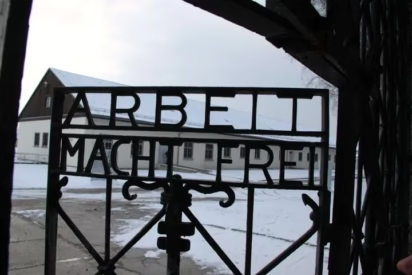
The main entrance to Dachau concentration camp is via the Jourhaus (SS offices), where the original “Arbeit Macht Frei” gate is. (Similar signs were used at many other concentration camps, including Sachsenhausen near Berlin and possibly most famously at Auschwitz.)
“Arbeit macht frei” is usually translated as “work sets you free” or, very literally, “work makes free”. Before the Second World War, prisoners were often released from Dachau, but never due to hard work.
Museum Exhibition and Barracks at Dachau
The main museum exhibition is in the large former maintenance buildings. Reading every display in the permanent exhibition alone can easily take more than three hours. No one can deal with such information (and emotional) weight in a single day. Descriptions (in English and German) and photos are graphic and not sanitized, making the museum unsuitable for children under at least twelve years old.
A 20-minute movie is shown several times per day in the cinema in the center of the building complex. It is absolutely worth seeing, especially for visitors with limited prior knowledge of Dachau and the concentration camp system.
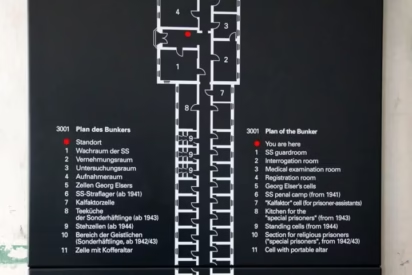
Parallel to the main building is the “bunker” or former camp prison (and torture center). Exit through the door at the end of the permanent exhibition or simply walk around the outside.
Two barracks have been reconstructed across from the roll call area. (The camp was used as a prisoner camp immediately after the Second World War and later as a refugee center for Germans made homeless in areas ceded to other nations after the war. During this period, the original barracks were altered or destroyed.)
In the barracks are three interiors showing how sleeping conditions deteriorated in the camp as the numbers often increased without expanding the size of existing buildings.
It is a long walk, and on a quiet day, surreally peaceful, from the reconstructed barracks along a tree-lined avenue past the foundations of other barracks to the back of the original camp. Here are Jewish, Catholic, Protestant, and Russian Orthodox chapels and memorials.
Crematorium and Deaths at Dachau
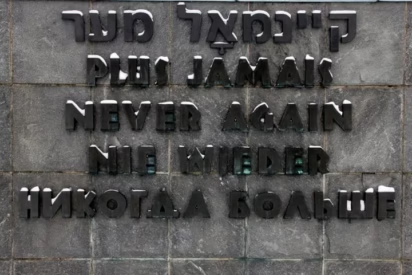
More disturbing is the Crematorium area with two original crematoriums. Officially, the gas chamber—which visitors may enter—was never used for mass murder, although it is hard to imagine it was never tested.
Dachau was not an extermination camp such as Auschwitz – large groups of Jewish and sick prisoners were sent elsewhere to be executed – but death from overwork, disease, malnourishment, and downright murder was common.
Officially, 32,000 deaths were recorded at Dachau – “only” 500 prior to 1939. However, many deaths were systematically not officially registered. The total number of people who died at Dachau is generally estimated at around 43,000.
Further related sites in Dachau include the Path of Remembrance between Dachau station and the camp, the plantation where prisoners were forced to do hard labor, the shooting range where many Soviet soldiers were murdered, a mass grave memorial site, and the graveyard where many prisoners, who died after liberation, were buried.
Visitor Information for Dachau Concentration Camp

The Dachau memorial grounds are open daily from 9 am to 5 pm. It is currently only closed on December 24.
Admission is free — no tickets or time-slot reservations are required.
The memorial site and buildings are almost fully accessible to wheelchair users.
Official guided tours in English are available a few times per day, while audio guides offer an alternative if desired. The descriptions in German and English are very comprehensive. Guided tours from Munich often include transportation.
Getting to Dachau Concentration Camp is easy on public transportation from downtown München or Munich Airport (MUC). If traveling from Munich, visiting Dachau is a half-day excursion. Expect to spend at least two to three hours at the camp, plus around an hour for transportation each way.
The best-known and most visited concentration camp memorial sites in modern Germany are Dachau (Munich), Sachsenhausen in Oranienburg (Berlin), Buchenwald (Weimar), and Bergen-Belsen (Celle / Hannover / Hamburg). Auschwitz-Birkenau is in modern-day Poland near Krakow.