Visit the Doria Pamphilj Gallery to see three Caravaggio paintings and Velázquez’s Pope Innocent X in one of Rome’s largest private art collections.
The Doria Pamphilj Gallery is one of Rome’s most impressive painting collections. The lavish display in the privately owned palace is largely unchanged from the 18th century. Top masterpieces include Velázquez’s Portrait of Innocent X and three paintings by Caravaggio: Rest on the Flight into Egypt, Penitent Magdalene, and John the Baptist (Youth with a Ram). The collection further includes representative works by many major artists of the 16th and 17th centuries. Walk-in tickets may be available, but advance reservations are recommended during busy periods.
Quick Guide: Doria Pamphilj Gallery in Rome
Top masterpieces: Velázquez’s Portrait of Pope Innocent X and paintings by Caravaggio, including Rest on the Flight into Egypt and Penitent Magdalene.
Why visit: One of Rome’s finest private art collections, displayed in a lavish palace with largely historic gallery arrangements.
Tickets: €16 at the museum or €17 online. Advance reservations are recommended during busy periods, but walk-in tickets may be available.
Opening hours: Monday, Tuesday, Thursday 9 am–7 pm; Friday to Sunday 10 am–8 pm. Closed Wednesday. Last admission is one hour before closing.
Time needed: Allow around 90 minutes, or longer to examine the paintings in detail.
Location: Via del Corso 305, near Piazza Venezia in central Rome.
Jump to:
Velázquez · Caravaggio · Top Paintings · Archaeological · Tickets · Opening Hours
Doria Pamphilj Gallery and Palace in Rome
The Galleria Doria Pamphilj is one of Rome’s largest and most impressive private art collections. The focus is on 16th- and 17th-century paintings, but the collection spans from antiquity and the Middle Ages to the 19th century.
For centuries, the Doria Pamphilj family (with historic links to the Landi and Aldobrandini families) was among Rome’s most important noble families, with close ties to the Roman Catholic Church and fabulous wealth.
The most prominent family member, Cardinal Giovan Battista Pamphilj, became Pope Innocent X in 1644. He, along with several generations of family members, actively collected art.
Visitors see some of the palace’s lavishly decorated public rooms, which some accounts describe as the largest still privately owned palazzo in Rome. However, the main attractions are the art displays in four corridors around a courtyard and a few separate gallery rooms.
Pamphilj is sometimes written as Pamphili, which resembles its pronunciation in many languages.
Visit Reception Rooms of the Doria Pamphilj Palace
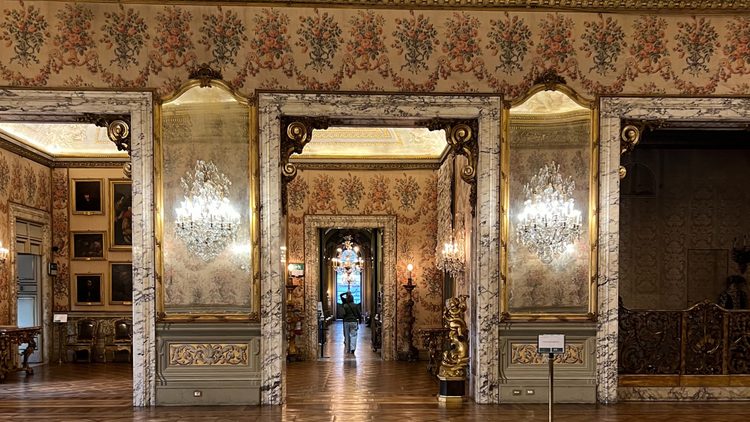
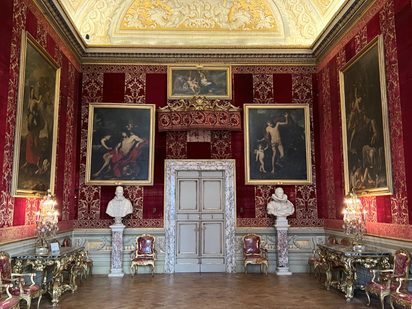
The visit to the Doria Pamphilj Gallery in Rome begins in a series of magnificent reception rooms that offer a glimpse into the aristocratic lifestyle of one of Italy’s most powerful noble families. These spacious, richly decorated halls were designed to impress with elaborately painted ceilings, gilded furnishings, sumptuous fabrics, marble sculptures, and paintings.
However impressive these reception rooms are, the main reason to visit the Doria Pamphilj mansion is to admire the family’s extraordinary art collection, displayed in a largely eighteenth-century arrangement.
Exploring the Historic Picture Galleries
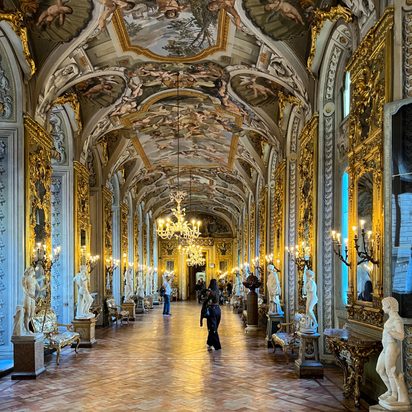
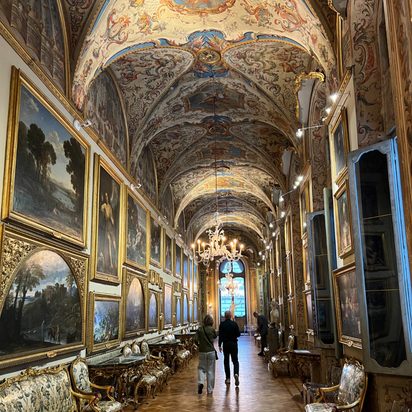
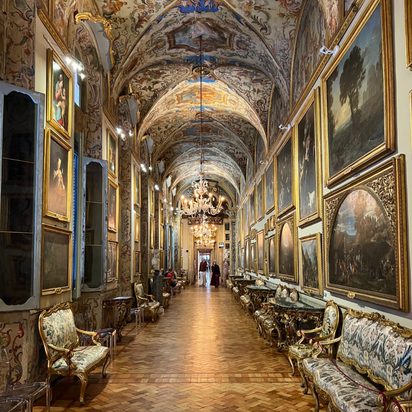
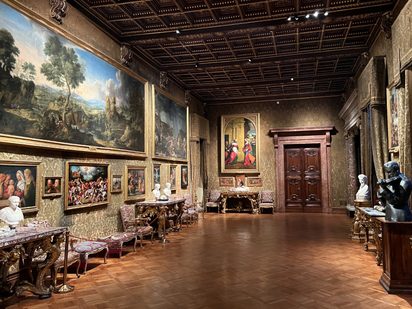
Unlike many modern art museums, which organize paintings by artist, period, or school, the Doria Pamphilj Gallery preserves much of the aesthetic of an aristocratic private collection. Paintings hang densely, and their placement often reflects symmetry and decoration rather than art-historical chronology.
Much of the art in the Doria Pamphilj Gallery is still displayed as the family did in the 18th century: tightly hung along the walls of four galleries around a central courtyard.
Particularly impressive is the second wing, or hall of mirrors, where the ceiling is painted with scenes from the life of Hercules, while the walls are lined with mirrors, marble sculptures, and paintings.
The lighting is not always ideal for examining individual paintings and changes according to the time of day. However, the gallery is a beautiful ensemble and representative of the residence of such a prominent, rich family.
Fortunately, the top works by Caravaggio, Velázquez, and Lippi are displayed in galleries with museum-quality lighting.
Top Masterpieces in the Doria Pamphilj Gallery
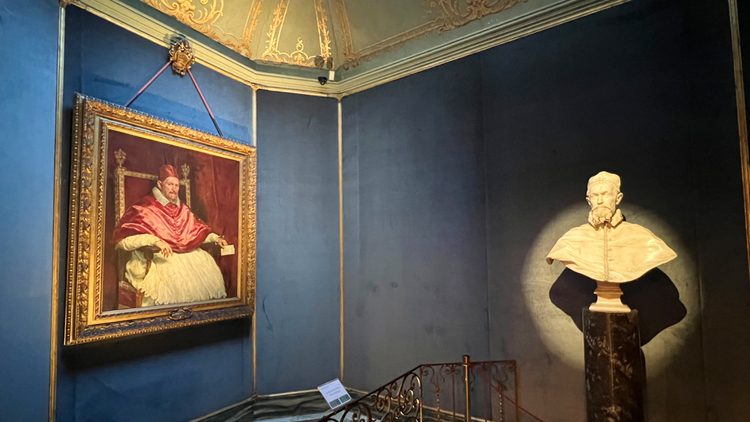
The undisputed top masterworks in the Doria Pamphilj Gallery in Rome are Velázquez’s Portrait of Innocent X and the three paintings by Caravaggio: Rest on the Flight into Egypt, Penitent Magdalene, and John the Baptist (Youth with a Ram).
Diego Velázquez’s Portrait of Innocent X
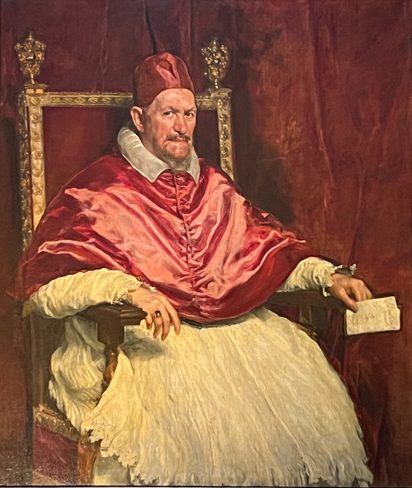
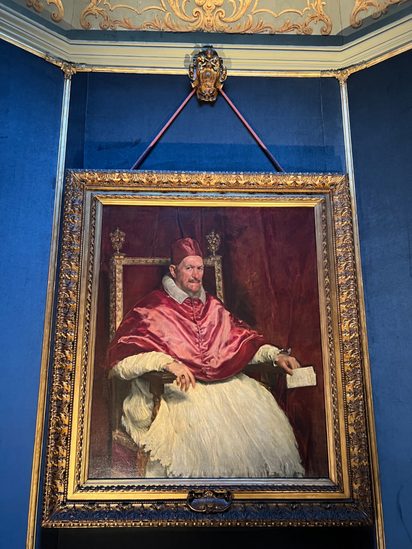
The Doria Pamphilj Gallery considers Diego Velázquez’s Portrait of Innocent X, 1650, 141 cm × 119 cm (56 in × 47 in), as its most important painting. It portrays the family’s most famous member, Cardinal Giovan Battista Pamphilj, who reigned as Pope Innocent X from 1644 to 1655.
Velázquez painted the pope very realistically, “without attempting to hide his ugliness.” Innocent X was not fond of the work — he thought it “too true!”
According to the gallery, many artists and art critics consider it the finest portrait ever created. It is hard to argue with Hippolyte Taine’s opinion that “once seen, it is impossible to forget.”
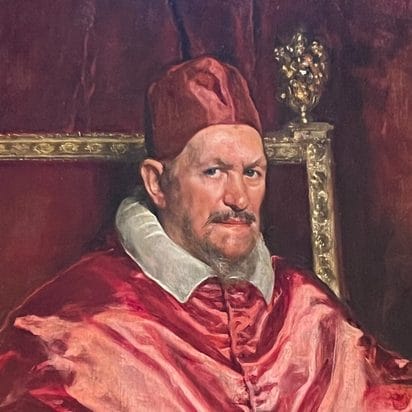
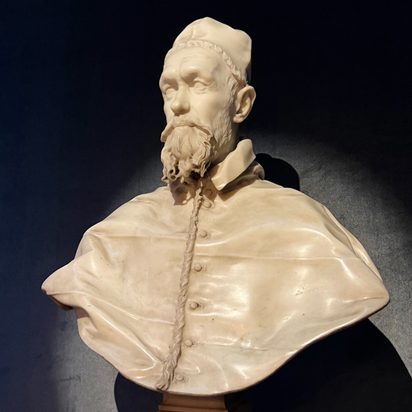
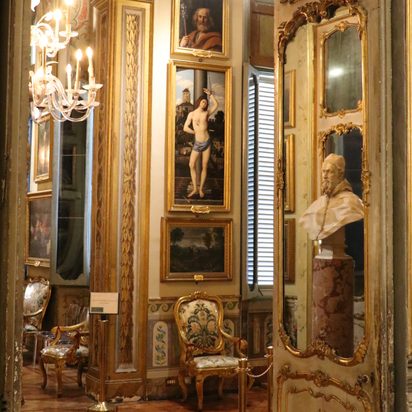
The portrait is currently displayed in a special chamber at the end of the first wing, alongside a Carrara marble bust of Innocent X by Gian Lorenzo Bernini. Both works were created around 1650, but Bernini gave the pope a far more heroic expression, as was the norm at the time.
An earlier bust by Bernini is also displayed elsewhere in the gallery. A flaw in the stone, visible below the beard, probably forced him to produce the second version now alongside the Velázquez. (A similar issue earlier forced Bernini to produce two busts of Scipione Borghese (1632), now displayed in the Borghese Gallery.
Caravaggio Paintings in the Doria Pamphilj Gallery
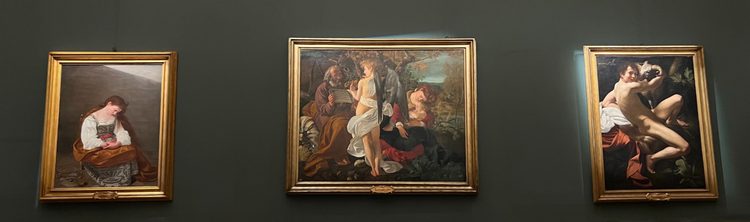
For many visitors, the three paintings attributed to Caravaggio, hanging side by side in the room at the end of the second wing, are the most popular works in the gallery:
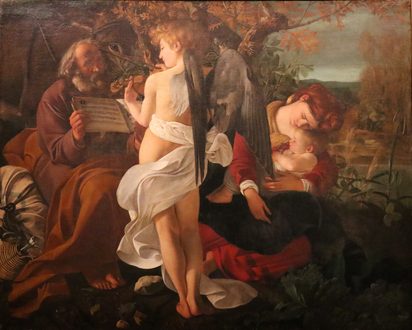
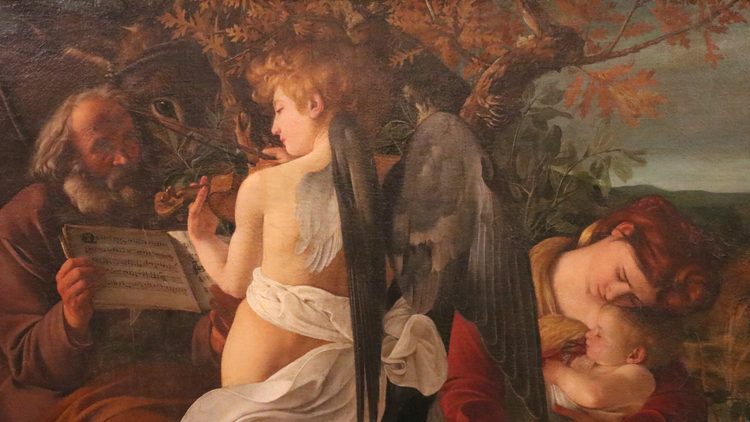
Rest on the Flight into Egypt, c. 1597, 135.5 cm × 166.5 cm (53.3 in × 65.6 in), is considered Caravaggio’s first large sacred painting. His composition of this popular theme is unusual. An idealized Madonna and child are asleep, while an angel at the center of the painting plays the viol from sheet music held by St. Joseph.
The landscape, which rarely gets much prominence in Caravaggio’s paintings, shows some influence from Lombard and Venetian paintings.
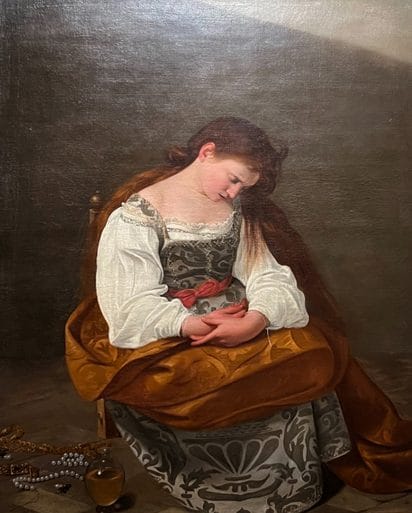
Penitent Magdalene, c. 1594–1595, 122.5 cm × 98.5 cm (48.2 in × 38.8 in), portrays Mary Magdalene bowed in penitent sorrow but unusually in contemporary dress. She has renounced her worldly life, as illustrated by the dropped string of pearls, jewelry, and a jar of unguent.
The light colors are typical of Caravaggio’s early paintings. The model was probably the same one used for the Madonna in The Rest on the Flight into Egypt.
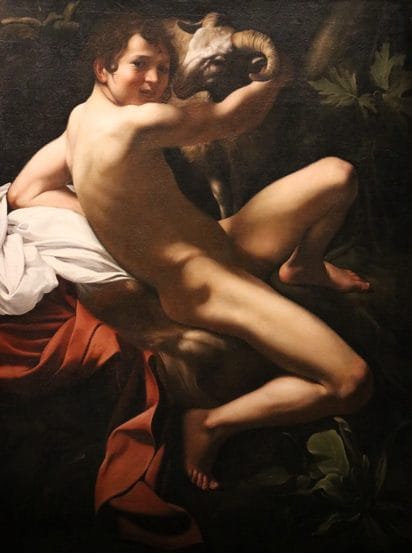
John the Baptist (Youth with a Ram), c. 1602, 129 cm × 94 cm (51 in × 37 in), is usually considered a copy painted by Caravaggio himself of the original painting now in the Capitoline Museums. (This attribution is sometimes disputed. A further, lower-quality copy hangs elsewhere in the gallery.)
The youthful, naked John is shown half-reclining, one arm around a ram’s neck. The painting is devoid of any religious symbols usually associated with John the Baptist, thus the alternative name Youth with a Ram.
The model was Cecco del Caravaggio, also seen in the famously erotic Amor Victorious, now in the Gemäldegalerie in Berlin.
The Pamphilj family’s fourth Caravaggio, the Fortune-Teller (now in the Louvre), was donated to Louis XIV. A different version is nearby in the Capitoline Museums.
Other Art Highlights in the Doria Pamphilj Gallery
A selection of other top artworks in the Doria Pamphilj Gallery, and a few personal favorites, include:
Marco Basaiti: Saint Sebastian
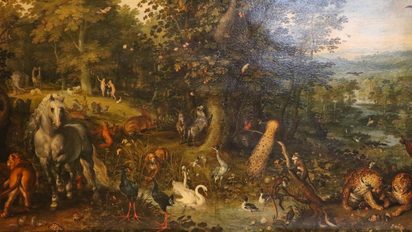
Jan Bruegel the Elder: Earthly Paradise with Original Sin, the latter almost an afterthought. The gallery has around a dozen works by Jan Bruegel, including several produced in cooperation with Hendrick van Balen.
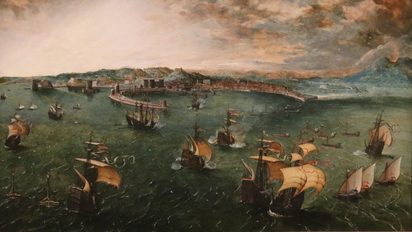
Pieter Bruegel the Elder: A Battle in the Bay of Naples and a fine copy of his Winter Landscape with Skaters and Bird Trap, done by Pieter Brueghel the Younger.
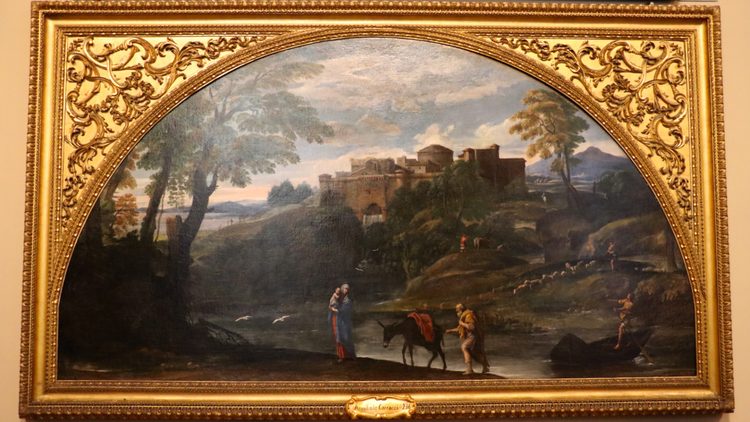
Annibale Carracci: several works, including Landscape with the Flight into Egypt (quite different from Caravaggio’s), Susanna and the Elders, and Satyr and Shepherd.
Correggio: Allegory of Virtue, 1525. This incomplete painting might have been the inspiration for Bernini’s sculpture Truth unveiled by Time (also incomplete and now in the Borghese Gallery, Rome)
Jusepe de Ribera: Saint Jerome, 1637
Guercino: Erminia discovers the wounded Tancred, 1618.
Hans Memling: Lamentation over the Dead Christ with a Donor, c. 1470s to 1480s.
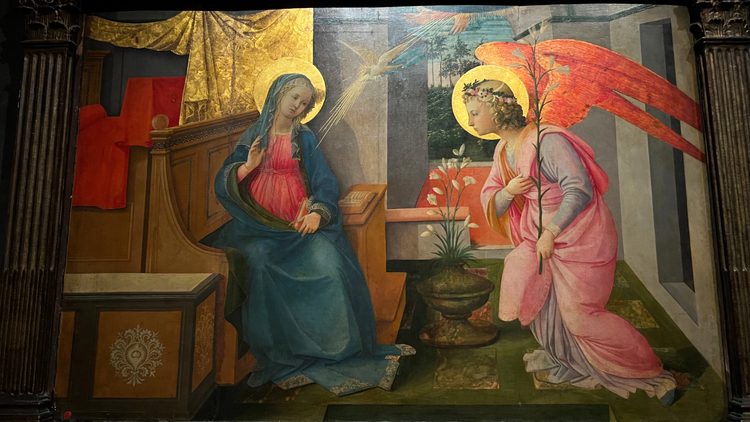
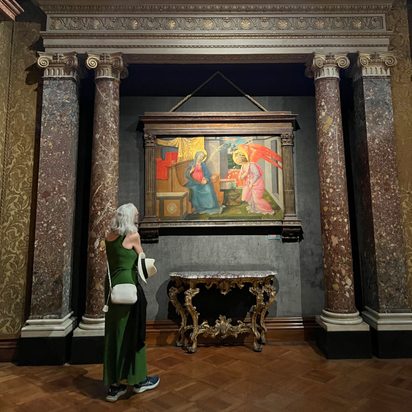
Filippo Lippi: The Annunciation, c. 1445-50. Unusually, the angel approaches Mary from the right.
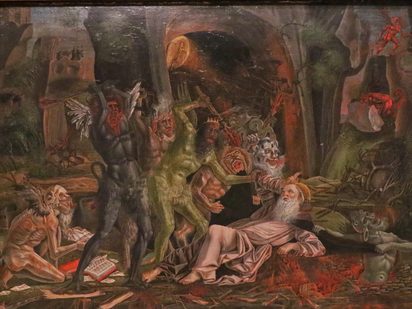
Bernardo Parentino: three paintings (c. 1480s) of scenes from the life of Saint Anthony Abbot illustrating Anthony giving his worldly possessions to the poor, the temptations of St. Anthony, and being attacked by demons.
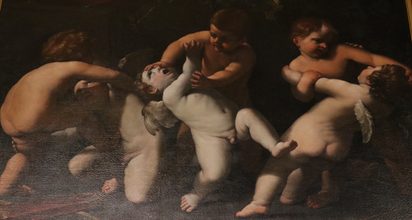
Guido Reni: Putti Fighting. Once referred to as “Plebeian putti fighting noble putti”, it is an early representation of social struggle portrayed through classical metaphor.
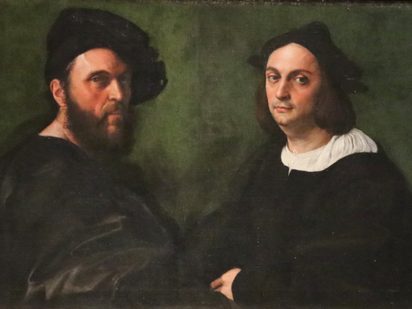
Raphael: Double portrait (Beazzano and Navagero) (c. 1516). Several good copies of other Raphael paintings are also on display.
Tintoretto: Portrait of a Young Gentleman (c. 1554).
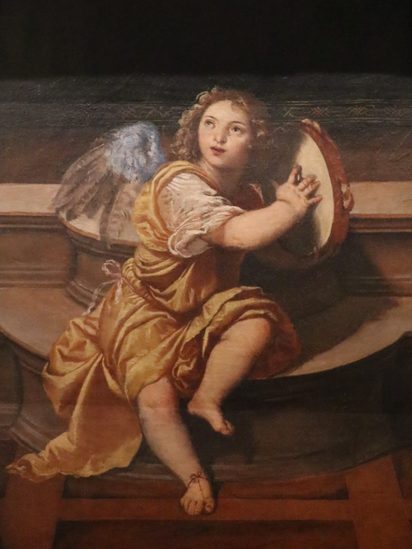
Titian: Salome with the head of John the Baptist (c. 1515), Angel with tambourine (c. 1508), and several good copies of Titian paintings.
Giorgio Vasari: Deposition from the Cross (c. 1544).
Veronese (and his workshop): Road to Calvary, Deposition from the Cross, and Adoration of the Shepherds.
Archaeological Items in the Doria Pamphilj Gallery
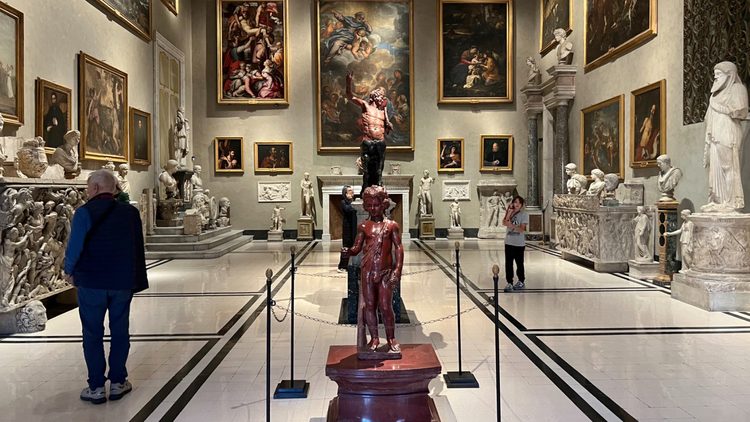
Many of the archaeological finds of the family’s original collection are now in other museums, especially in the Louvre and Capitoline Museums, but several are exhibited in the Aldobrandini Hall (Salone Aldobrandini), including:
- Personification of the Nile with a crocodile, ca. 2nd century
- Sarcophagus with a procession of Bacchus on a chariot drawn by panthers
- Roman sarcophagus with a scene of a wild boar hunt, Calydonian and funeral procession
- Roman sarcophagus with stories of Apollo and Marsyas among the Muses
- Statue of Silenus, Imperial Age
- Ulysses escaping beneath one of Polyphemus’s goats, 1st-2nd century.
- Young Centaur, a Roman work in coloured marble dating from the Antonine period (second century AD) and inspired by the “Furietti Centaurs” from Hadrian’s Villa, now in the Capitoline Museums.
Visitor Information for the Doria Pamphilj Gallery in Rome
Opening Hours of the Doria Pamphilj Art Gallery
The Doria Pamphilj Gallery is open:
- Monday, Tuesday, and Thursday from 9.00 a.m. to 7.00 p.m.
- Friday, Saturday, and Sunday from 10.00 a.m. to 8.00 p.m.
Final admission is an hour before closing time.
The gallery is closed on Wednesdays. In addition, the gallery closes on 1 January, Easter Sunday, and 25 December.
The average visit takes around 90 minutes, but art lovers can easily spend much longer in this wonderful museum.
Note: The Doria Pamphilj Gallery has no cloakroom and only very small bags are allowed inside the museum. Book luggage storage nearby.
Tickets and Tours for the Doria Pamphilj Art Gallery
Admission tickets for the Doria Pamphilj Art Gallery are €16 if bought on-site and €17 for advance online purchases. Audio guides are included, although the supply is limited.
Admission is free for children under the age of 12
Guided tours are frequently available, but there is really no need to ever pay more for basic admission tickets than the official prices.
Online ticket holders can proceed directly to the museum entrance on the first floor and enter within the reserved half-hour time slot. Visitors unable to climb the flight of stairs should contact the museum in advance to enquire about other solutions.
Time-slot reservations are sensible in the high season, but it is easy to confirm on the official website how many tickets are available for any given day and time slot.
When I visited the museum in mid-October 2026, tickets were available for all time slots on any day, while the Borghese Gallery was sold out for the following four weeks and the Vatican Museums for the following ten days. Tickets for immediate entry were similarly available for the equally impressive Barberini Gallery.
Getting to the Doria Pamphilj Art Gallery
The Doria Pamphilj Art Gallery is inside Palazzo Doria Pamphilj at Via del Corso 305, Rome, very close to Piazza Venezia and the Capitoline Museums.
The Doria Pamphilj Secret Apartments are in the same building on Via del Corso as the Doria Pamphilj Gallery but are under different management, with different opening hours and ticket windows.
Don’t confuse the Doria Pamphilj Gallery with the Villa Doria Pamphilj in the Monteverde district, the Palazzo Pamphilj in Piazza Navona (now the Brazilian Embassy), or the Palazzo Doria Pamphilj in Valmontone.