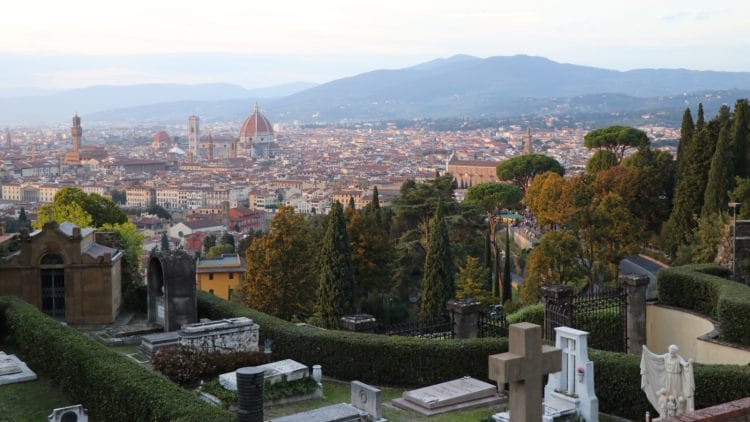
The San Marco Museum in Florence is famous for its large collection of paintings by Fra Angelico, including original frescoes in the cells of the convent.

The San Marco Museum in Florence is in the former Dominican convent, where the cells and art of the monastery have been preserved. Fra Angelico designed frescoes for each of the 44 cells that survived in very good condition. The museum also has a large collection of other works by Fra Angelico on display, including the world-famous Annunciation frescoes, several Madonnas, and crucifixion paintings. Other works are by, amongst others, Fra Bartolomeo and Domenico Ghirlandaio. Although the main themes are of course very religious in nature, most visitors would be able to appreciate the quality of the art apart from the religious symbolism too. Buy skip-the-line tickets online in advance to visit the San Marco Museum in Florence without queuing.
Visitor Tips: See 2026: Opening Hours of Top Museums and Churches for the latest ticket and visitor information for Florence’s top sights. The FirenzeCard may offer savings, while the Turbopass Florence City Pass includes reservations for the Uffizi and Accademia.
Renaissance San Marco Monastery in Florence

The Dominican Order moved into San Marco in 1437 after the high-living Sylvester order was thrown out. By that time, the Sylvesters had sold many of the best artworks, and a fire ruined much of the building.
Cosimo the Elder, an important patron of the Dominicans, instructed (and paid) his favorite architect, Michelozzo, to rebuild the convent. This was done, mostly between 1436 and 1446, in a simple, elegant style, adding some early Renaissance flair to the Gothic.
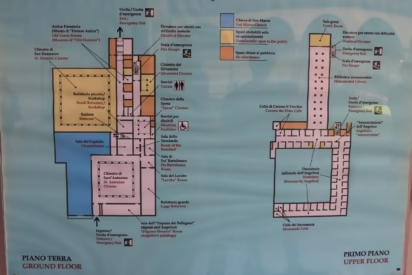
The most famous friar in the nearly 600-year history of the Dominican San Marco was Fra Angelico (c. 1395-1455), who painted frescoes in the cells but also exquisite altarpieces and similar religious works. A large collection of his artworks is on display in the museum. Another famous painting brother was Fra Bartolomeo (1472-1517) — his works inspired Raphael.
Fra Savonarola (1452-1498) was the prior of San Marco and briefly took control of Florence away from the Medicis. His campaigns against earthly delights and degenerate art, including bonfires of the vanities, ended with his public hanging and being burned in front of the Palazzo Vecchio in 1498.
Visit the Convent and San Marco Museum in Florence
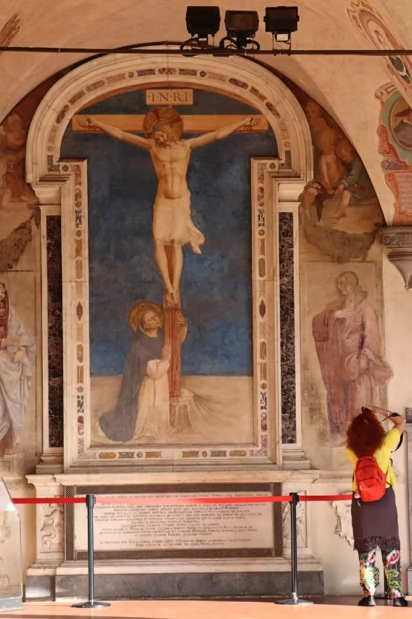
The entrance to the San Marco Museum in Florence is directly to the right of the Baroque church facade. Immediately after the ticket window, visitors enter the peaceful St Antonino Cloister with one of Fra Angelico’s crucifixion frescoes right in front — there are around two dozen crucifixion frescoes in this convent. (The slightly bigger St Dominic Cloister at the back of the building is not always open to the public.)
In this Crucifixion fresco, St Dominic hugs the cross. St Dominic — usually easily identifiable by the small red star above his head — repeatedly appears in frescoes in the convent, especially at biblical events where he obviously could not have been. These frescoes show events that are particularly important to the Dominicans. The frescoes should encourage contemplation and thought rather than be considered decorations of historical records.
Most of the other frescoes in this cloister were painted during the 17th century by various Florentine artists after the monastery decided to celebrate St Antoninus (1389-1459), who was prior of San Marco from 1439 and bishop of Florence from 1446.
Pilgrims Hospice – Fra Angelico Museum

The former Pilgrims Hospice is directly to the right of the entrance. In this room hang the largest number of Fra Angelico paintings on wood in the world.
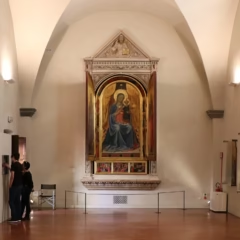
Some of the works here include:
- Deposition from the Cross
- Triptych of St Peter Martyr
- Annalena Altarpiece
- Wardrobe of the Silversmiths
- Last Judgment
- Altarpiece from San Marco Church
- Tabernacle of the Linaioli with marble frame designed by Lorenzo Ghiberti
→ See Top Art of Fra Angelico in the San Marco Museum in Florence for more details on these works and the life of Fra Angelico.
Large Refectory and Fra Bartolomeo Paintings

Further paintings are on display in the Lavabo and adjoining rooms, including the Large Refectory. The large crucifixion with St Domenic and the Brothers being served by angels is by Giovanni Antonio Sogliani. It gave the friars a lot to contemplate while eating meals, generally in silence.
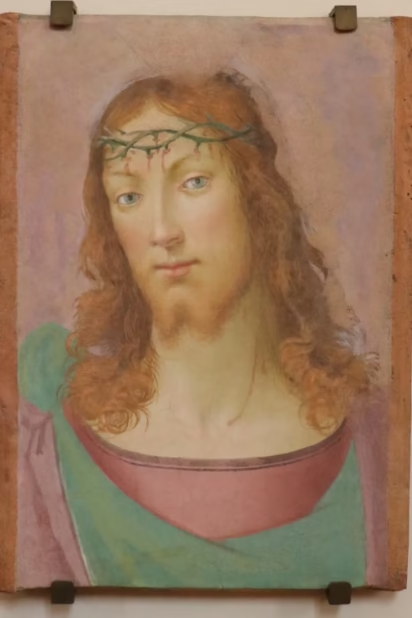

The most interesting paintings here are by Fra Bartolomeo (1472-1517), who was also a resident of the convent. He influenced a young Raphael, and in return, the works of Raphael also influenced Fra Bartolomeo’s later works, especially his use of light.
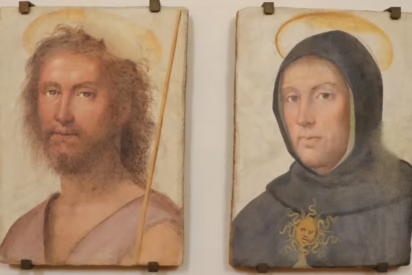
Several portraits by Fra Bartolomeo are on display: Ecce Homo shows an idealistic, blue-eyed Christ, while the portrait of St Dominic reminds us that this is supposed to be a silent order. Further portraits include St Thomas Aquinas and John the Baptist.
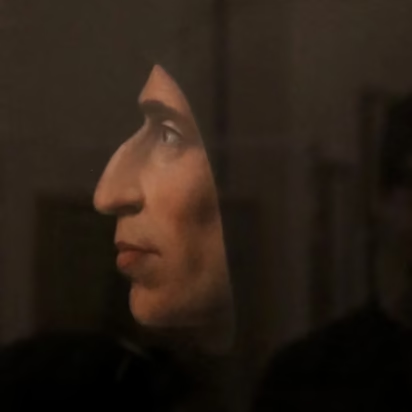
A famous work is the side profile portrait of Fra Savonarola. Under his influence, Fra Bartolomeo gave up painting for several years but resumed painting in a High Renaissance style from 1504 onwards.
Chapter House of San Marco Convent in Florence
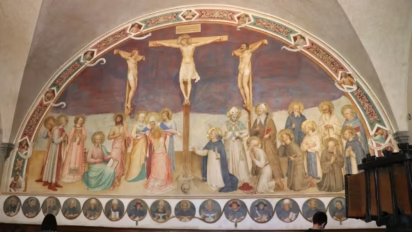
The large Crucifixion with Saints in the Chapter House is by Fra Angelico. In addition to biblical figures, several saints and founders of religious orders are included in the scene.
The sky was originally blue — as may still be seen in several of the works in the Hospice. The reddish appearance is the original preparation of the plaster — the blue paint has literally dropped off.
Monks’ Cells in the San Marco Museum in Florence

A highlight of a visit to San Marco is the preserved monks’ cells on the upper floor of the convent building. These single cells were spartanly furnished and are now empty, but are famous for the simple frescoes intended to encourage contemplation.
The upper floor and the monk cells close already at 13:30, so don’t visit this area last when arriving at the museum in the early afternoon.
Annunciation Fresco by Fra Angelico

At the top of the flight of stairs leading to the sleeping quarters is arguably the most famous and most-copied work ever of Fra Angelico. This large Annunciation fresco (1439-43) shows the archangel Gabriel announcing to Mary that she is pregnant with the son of God. She does not seem particularly excited by the news, with a face of acceptance and humility. She typically wears blue as a symbol of royalty and purity.

More impressive than the facial expressions of this work are the composition and the use of perspective, especially with the arcades, which show promise of the early Renaissance. Also, in contrast to typical High Gothic paintings, the setting is outside rather than indoors. The wings of the archangel are not only colorful, but the paint also contains glitter, which sparkles especially in candlelight.
The message at the bottom was a reminder to the monks to pray — when you come before the image of the Ever-Virgin, take care that you do not neglect to say an Ave.
Fra Angelico painted the Annunciation in two frescoes in this convent and three times on wood panels. (None of these panels are in this museum.)
Further frescoes by Fra Angelico in the passages include a large crucifix with St Dominic and a Madonna and Child / Our Lady of Shadows (between cells 25 and 26). It features several saints important to the Dominicans, but also the patron saints of the Medicis, including Saints Cosmas and Damian.
Cells of San Marco Monastery in Florence

The convent of San Marco has 44 monk cells or bedrooms. Almost all had frescoes. Fra Angelico probably designed all, but debate continues on how much he painted in person.
The cells in the corridor directly behind the Annunciation were for the clerics. The ones on the left side are usually considered to have been painted by Fra Angelico himself. These were the cells for the more senior friars — as the frescoes were not intended as decorations but to encourage contemplation, these were more complicated and more challenging than those suitable for younger friars and novices, who slept in the larger cells around the corner.
Fra Angelico Cell Paintings
The frescoes in the first 11 cells on the left are largely attributed to Fra Angelico. They have the following themes:


- Noli me tangere / Touch Me Not! — Christ has risen and tells Mary not to touch him. (Books have been written on the translation and interpretation of these words!)
- Lamentation
- Annunciation — a simpler version than in the hallway but with a series of arches that copy the cell and give the impression of a passage leading through the wall.
- Crucifixion with St Dominic and St Jerome.
- Adoration of the Child — the ox and the donkey are from the apocryphal gospel of Matthew. Similar settings with the baby basically directly on the ground appeared in many other works from the period.
- Transfiguration — Christ with the apostles Peter (with raised arms), James, John, and the prophets Moses (left) and Elia (right), the Madonna and St Dominic.
- Christ Mocked in the presence of the Virgin and St Dominic.
- Christ has Risen from his sepulcher.
- Coronation of the Virgin — from left: Saints Thomas, Benedict, Dominic, Francis, Peter Martyr, and Paul.
- Presentation in the Temple.
- Madonna and Child — off the main cell.
Other Cell Paintings


The frescoes on the walls of cells on the right-hand side are usually attributed to the assistants painting to the designs of Fra Angelico. Themes include several crucifixions, but also the baptism of Christ and some with iconography not in the standard bible.
The frescoes in the cells of the novices are simply a repeat of the crucifixion with St Dominic in each of the nine cells in a different position of prayer. These cells were slightly bigger too, to give novices a chance to adapt to smaller spaces.
Cells of Fra Savonarola in San Marco
At the end of the corridor, past the cells of the novices, are the three rooms of Fra Savonarola. These are larger than the other cells, not because he was prior, but rather because they originally were used as storage rooms. Items related to Savonarola are on display in this room, including his simple coat, rosary, and a piece of timber saved from his pyre.
Girolamo Savonarola (1452-1498) was a Dominican friar who came to San Marco in 1490. He was a fiery preacher who denounced clerical corruption and turned Renaissance Florence briefly against art and luxuries. He famously had bonfires of the vanities in Florence. Savonarola took de facto control of much of the city in 1495 and drove out his previous patrons — the Medicis.

The increasingly repressive regime and a reign of terror ended when a mob stormed San Marco to arrest Savonarola and three further priests. They were defrocked, hanged, and finally burned in the Piazza della Signoria in front of the Palazzo Vecchio on 23 May 1498, as shown in the famous painting here of the event by an unknown artist. (A plaque in the square marks the spot too.)
Medici rule was restored eventually and strengthened in Florence. However, in Saxony, a certain German Monk Martin Luther, read and found inspiration in some of Savonarola’s ideas.
Dormitory for the Lay Brothers
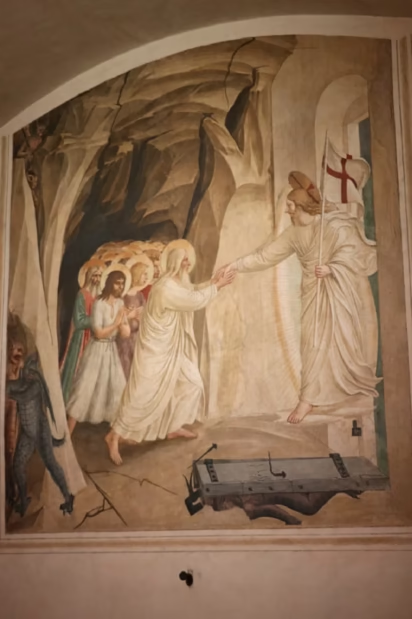
The cells in the corridor with the Annunciation fresco often accommodated lay brothers and visitors. Some here also have more complex frescoes, but many are considered not to be the work of Fra Angelico.
Some of the more interesting frescoes include Christ bursting into limbo by kicking the vaulted door of hell in and trapping a devil underneath it. Further devils cower in terror in dark corners.
Other frescoes, generally not attributed to Fra Angelico, include the Sermon on the Mount, the Temptation of Christ, the Agony in the Garden of Gethsemane, and several crucifixion scenes.
At the far end of this corridor — the last cell on the right and a further room off it — are the so-called Cells of Cosimo the Elder. He financed the rebuilding of the convent and occasionally used these rooms as a retreat. The use of gold leaf and azurite in the frescoes here confirms that these were for a wealthy patron, not for a humble monastery.

The large Adoration of the Magi is often attributed to Fra Angelico with assistance from Gozzoli, or v.v. The crucifixion fresco features the patron saints of Cosimo the Elder — Saints Cosimo and Damian. They are also seen on several of the altarpieces on display in the hospice.
Monumental Library of San Marco
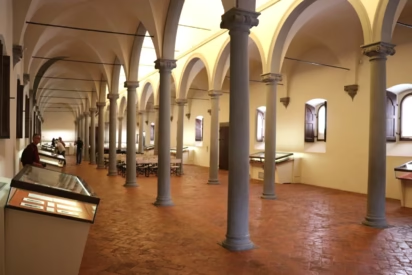
Also, off this passage is the large monumental library. This large library was designed by Michelozzo and, like the later Biblioteca Medicea Laurenziana designed by Michelangelo at San Lorenzo, was open to the public.
It was originally built to house the collection of the humanist Niccolò Niccoli (1365-1437), but Cosimo the Elder donated further works. The pluteuses and other original furnishings were stripped out to reveal the bare architectural features of this library. Like a basilica, it has three naves and arched vaulted ceilings.
Some historic books are on rotating display — many were originally copied and illustrated in San Marco.
Ground Floor of San Marco Convent

Back on the ground floor, visitors see a few further small rooms and cloisters on the way to the exit at the back of the building. Although the last brothers moved out in 2014 — to Santa Maria Novella — several rooms and cloisters remain private, or only open on occasion.
In the small refectory (with bookshop) is a further Last Supper fresco by Ghirlandaio, who also painted the Tornabuoni Chapel in Santa Maria Novella. Judas, as is often the case in these paintings, sits isolated on the opposite side of the table from the other disciples and Christ.
The long passage to the entrance is known as the Museum of Old Florence — it is lined by decorative items that survived from old buildings in central Florence that fell to changes in taste and the desire to modernize during the nineteenth century.
San Marco Church in Florence

The Church of San Marco is less grand and somewhat smaller than the majestic Baroque facade may suggest. It is worth peeking in if open — admission is free, but opening hours are shorter than those of the museum.
Visitor Information for San Marco Museum in Florence


The San Marco Museum is open Tuesday to Sunday from 8:15 and closes at 13:50. (Note the monk cells and upper floor already close at 13:30.)
These simplified hours are in use in 2026 — some older guidebooks still have the museum open on some Mondays.
Admission tickets to the museum are €11, free for children under 18, and €2 for EU nationals aged 18 to 25. The Firenze Card is accepted (free time-slot reservations possible).
Visiting early is sensible and make time-slot reservations (small surcharge) during busy periods. The museum is popular, and although not as busy as many other Florentine sights, it does not take many visitors to make the cells feel crowded.
The San Marco Museum is on the large and busy with buses, Piazza San Marco, just half a block north of the Accademia. Tram 2 (direct connections to Santa Maria Novella train station and the airport) also stops at this square.