Top highlights and best paintings in the Gemäldegalerie in Berlin include early German works, Rembrandt and the Dutch Golden Age, Italian Renaissance, and Caravaggio’s Amor Triumphant.

The Gemäldegalerie (Paintings Gallery) in Berlin is one of the world’s most important art museums. It has around 1,300 paintings on permanent display, including works of astonishing quality by such artists as Rembrandt, Vermeer, Cranach, Dürer, Botticelli, and Raphael. The museum covers European Old Masters from the early Renaissance to the classical (ca. 13th to 18th centuries). The collections of Italian Renaissance, early German, and Dutch Golden Age paintings are amongst the best in the world. Caravaggio’s Amor Victorious is possibly the most popular work in the museum, but further Gemäldegalerie highlights are 17 Rembrandts and two Vermeers. Buy Gemäldegalerie tickets online for skip-the-line admission.
Gemäldegalerie Highlights: Quick Guide
📍 Location:
Gemäldegalerie im Kulturforum, Berlin
⭐ Best known painting:
Caravaggio’s Amor Victorious
🎨 Most famous artists:
Carravagio, Rembrandt, Vermeer & Raphael
🖌️ Most important German painters:
Lucas Cranach & Albrecht Dürer
🖼 Rare works:
Two Vermeer paintings
⏱ Time needed:
2 – 4 hours
🇮🇹 See also:
Italian highlights
🎟 Best ticket:
Kulturforum Day Ticket if visiting more than one museum.
Why Visit?
The Gemäldegalerie is Berlin’s best museum for Old Masters paintings, including Caravaggio’s Cupid as Victor, two by Vermeer, many by Rembrandt, Cranach, Dürer, Holbein, and Rubens.
Famous Paintings in the Gemäldegalerie in Berlin

The Gemäldegalerie in Berlin combines quantity and quality. For visitors, this is a magnificent dilemma — which paintings to study, as it is simply impossible to take it all in on a single visit.
The most famous painting displayed in the Gemäldegalerie is Caravaggio’s Amor Victorious; also known as “Omnia vincit amor” / Amor als Sieger / Amor Triumphant / Love Conquers All, Victorious Cupid, Love Triumphant, Love Victorious, or Earthly Love.
The Italian collection in Berlin further includes top early Renaissance paintings and multiple works by Raphael, Titian, and Botticelli. The later Italian galleries also include Canaletto’s detailed Venetian views.
The museum is particularly famous for its early German and Dutch Golden Age paintings. It has over 20 works by Lucas Cranach, a handful by Albrecht Dürer, and top works by Jan van Eyck and Rogier van der Weyden. The Gemäldegalerie currently has 17 paintings by Rembrandt and two by Vermeer.
Jump to:
German · Italian · Dutch · English · Cranach · Dürer · Rembrandt · Vermeer
Best Artworks to See in the Gemäldegalerie in Berlin
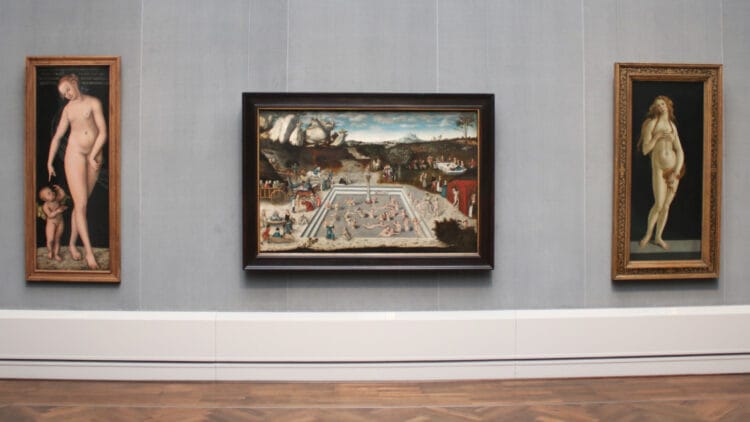
The Gemäldegalerie in Berlin has a collection of paintings of astonishing depth and quality. Most galleries in the world would be delighted to display any ten paintings randomly taken from this art museum’s walls.

The works described below are not an ordered top ten but rather some interesting paintings described in the order of the numbered halls, following the route most visitors take through the museum. It thus starts chronologically with early German paintings, followed by Flemish and Dutch paintings, and culminates in the Dutch Golden Age at the halfway point through the museum.
The chronology is reversed, starting with European paintings from the 18th century (English, French, Spanish, German) and then the marvelous Italian works — first the popular 17th and 18th-century paintings and finally the astonishing Italian Renaissance collection.
→ See also Tips on Visiting the Gemäldegalerie for visitors’ information, such as tickets and opening hours.
Gemäldegalerie: 200 Masterpieces of European Painting is a beautiful book (but heavy and pricy) — much of the information in the book is available for free when searching the online catalog of the Gemäldegalerie.
Top Ten Artists and Famous Paintings in the Gemäldegalerie in Berlin
- Caravaggio — Amor Victorious / Cupid as Victor / Omnia vincit amor
- Rembrandt — Self-portrait, Moses with the Tablets of the Law, and other works
- Vermeer — The Glass of Wine and Woman with a Pearl Necklace
- Cranach — The Fountain of Youth, Venus and Amor, and others
- Botticelli — Venus, The Virgin and Child with Singing Angels,
- Jan van Eyck — Madonna in the Church
- Titian — Venus with an Organist
- Raphael — several Madonna paintings, including the Terranuova Madonna
- Dürer — Hieronymus Holzschuher
- Holbein — The Merchant George Gisze

- See Top Italian Renaissance and Baroque Highlights for more details and photos of paintings in this amazing collection in the Gemäldegalerie in Berlin
German Highlights in the Gemäldegalerie in Berlin
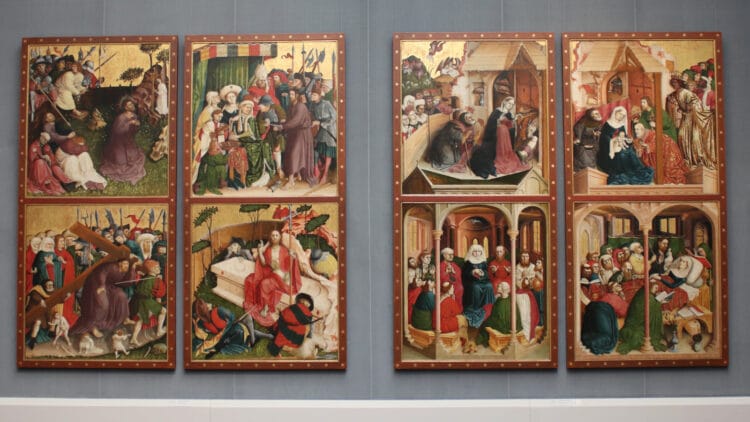

German paintings in the Gemäldegalerie date from the 13th to 18th centuries, although the best works are from before 1600. Many of the best paintings are smaller works and thus hang in the cabinets (1-7) rather than in the larger halls (I-VI), where religious works usually dominate.
Even if you are not religious, it is worth studying the details in the art. Even devout Christian visitors may struggle to identify many of the earlier religious symbols and scenes without a good guide.
An early highlight is the Flügel des Wurzacher Altars / Wings of the Wurzach Altar (1437) by Hans Multscher. It has four scenes from the life of Mary and four from the Passion of Christ.
Der Kaufmann Georg Gisze / Portrait of George Giese (1532) by Hans Holbein the Younger shows how far art developed in a century. This portrait of a Hanseatic merchant in his London office is a detailed painting full of symbols and symbolism.
Lucas Cranach in the Gemäldegalerie in Berlin

The Gemäldegalerie has 22 works by Lucas Cranach the Elder (1472-1553) — the German painter most strongly associated with the Reformation. The industrious Cranach was at ease with painting Biblical scenes for both Catholic and Lutheran clients, portraits of Luther and the nobility, expensive clothes and nudes, realism, and mythical figures.
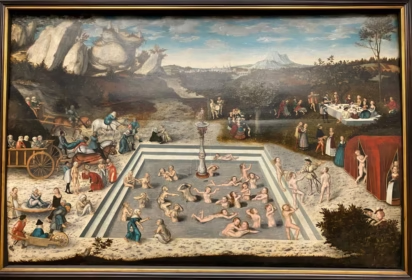
Several of his works are usually on display in the Gemäldegalerie to show his versatility and the breadth of his work:
Der Jungbrunnen / Fountain of Youth (1546) is probably not his best work, but it is fun and popular. Old and sickly women arrive on the left, and after wading or swimming through the fountain of youth, emerge on the right side young and healthy. Venus and Cupid are at the center of the fountain. Appropriately, two large paintings of Venus and Amor by Cranach are usually displayed on either side of the Fountain of Youth. (Compare these with Botticelli’s Venus, usually in Hall XVIII.)


Lucas Cranach’s Adam and Eve is remarkably similar to his Apollo and Diana, while Lucretia was always a suitable excuse for a nude female.
Cranach’s Copy of Hieronymus Bosch’s The Last Judgment

Another remarkable painting is the Flügelaltar mit dem Jüngsten Gericht / Wing Altar of the Last Judgement. Around 1525, Cranach painted this accurate copy of Hieronymus Bosch’s altar (now in Vienna), probably on commission from the Elector of Saxony. The small section on the Garden of Eden is fairly normal, but the rest of the work is literally hell on earth. The devil really is in the details here. It is quite interesting to compare Bosch’s vision of hell with other paintings in the museum, especially those by Italian painters strongly influenced by Dante.
→ See more photos of Cranach’s copy of Bosch’s Wing Altar of the Last Judgement at Flickr.
Albrecht Dürer in the Gemäldegalerie in Berlin
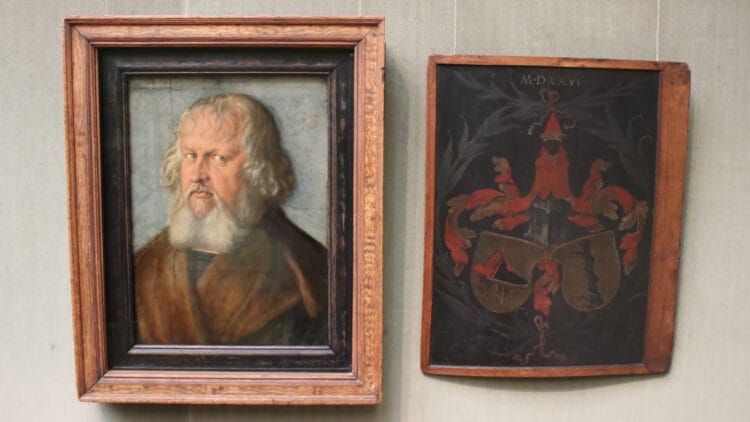
Albrecht Dürer (1471-1528) is probably the most praised German artist, although Caspar David Friedrich is currently more in vogue (and exhibited in the Alte Nationalgalerie). Dürer brought the Renaissance to German art and is famous for his paintings, sketches, and prints. He also influenced Italian artists, especially with his engravings.
The seven Dürer paintings in the Gemäldegalerie are not amongst his best-known works, but still illustrate his mastery, especially in portrait painting.
Dürer’s portrait painting expertise was highly valued by rich clients — he painted numerous emperors and nobility. However, he was not your first choice if you prefer your portrait with filters — he tended to paint warts and all, or as in the case of The Portrait of Hieronymus Holzschuher (1526). Ignore the combover hairstyle and admire Dürer’s skill in painting hair. (Hieronymus was a close friend of Dürer, and the portrait was probably not intended for public display.)


Die Madonna mit dem Zeisig / Madonna with the Siskin (1506) is an early work he painted while in Venice. It is full of symbolism related to the later beatification of the Virgin and famously has a note on the table bearing Dürer’s trademark AD sign.
Dutch Paintings in the Gemäldegalerie in Berlin

The Gemäldegalerie’s collection of Dutch and Flemish paintings from the 14th to 17th century is equally praised, with the collection of Dutch Golden Age paintings of the 17th century one of the best collections in the world.
Dutch Paintings 14th to 16th Century
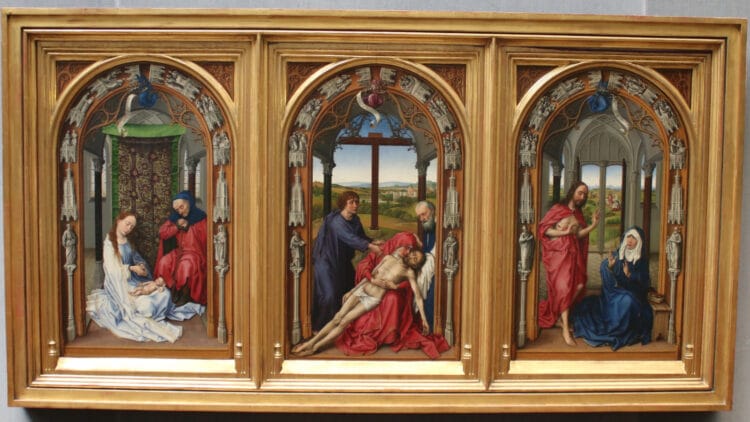
The three Jan van Eyck paintings are considered amongst his best works, and these early works are complemented by four paintings by Petrus Christus and remarkable altars by Rogier van der Weyden. Further early Dutch works on display are by Hugo van der Goes, Hans Memling, Jan Gossaert, Pieter Bruegel the Elder, and Hieronymus Bosch.


Bosch’s Johannes auf Patmos / Szenen der Passion Christi / John on Patmos / Scenes from the Passion of Christ (1500) is not the riot of his Last Judgment (that Cranach copied) but still anything but straight-laced.
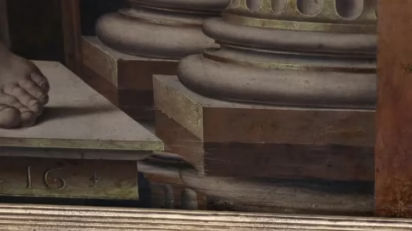
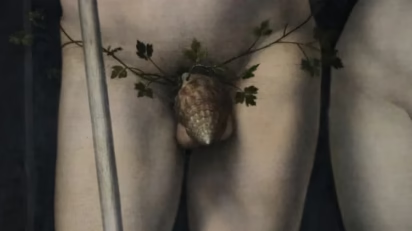
At first glance, Jan Gossart’s large paintings of Neptune and Amphitrite (1516) and Adam and Eve (1525/30) are easily confused. Neptune is the one with the trident and the seashell g-string that tends to attract rather than avert attention from his genitals. Also, note how the pillars are reflected in the water to remind us that he is the sea god.
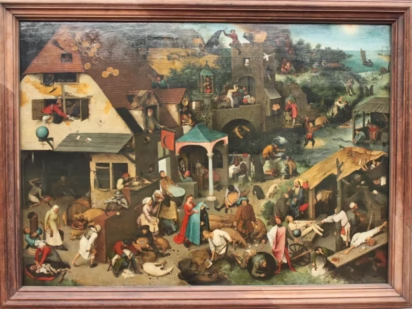
In Die niederländischen Sprichtwörter / The Dutch Proverbs (1559), Pieter Bruegel the Elder illustrated a hundred proverbs in a busy town scene. Dutch, like most Germanic languages, is rich in proverbs, although they were even more commonly used in the 16th than in the early 21st century.
The painting was previously also known as The Upside-Down World due to the upside-down globe. The Dutch saying that the world is standing on its head (De wereld staat op zijn kop!) is still very much in use today. Also note the spilled porridge, which is similar to “spilled milk” in modern English.
Flemish Masters of the 17th Century

The collection of Flemish paintings of the 17th century includes around 200 works, but only a limited number are exhibited. The curators could pick from 17 paintings by Peter Paul Rubens, 7 from Anthony van Dyck, and many by the extended Brueghel family.
Popular Rubens paintings in the museum include Der heilige Sebastian / St Sebastian (1618), which was inspired by Michelangelo statues Rubens saw on a trip to Italy, the Perseus befreit Andromeda / Perseus Freeing Andromeda (1620-22), and the much later Andromeda (1638).
[The largest collection of Rubens paintings in the world is in the Alte Pinakothek in Munich — another German art museum with paintings of astonishing quality.]
Dutch Paintings of the 17th Century (Golden Age)

The Gemäldegalerie’s collection of Dutch Golden Age paintings is amongst the best in the world and probably only surpassed by the Rijksmuseum in Amsterdam. At the core of the collection are 17 paintings by Rembrandt, but all Dutch masters from the period are represented.
Rembrandt Highlights in the Gemäldegalerie in Berlin

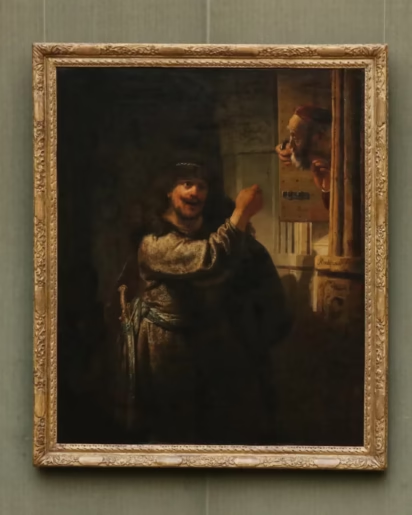
The 17 paintings by Rembrandt van Rijn (1606-1669) in the Gemäldegalerie include a rare landscape painting, many Biblical themes, famous people of his time, and several self-portraits. These paintings, as well as several from his workshop or circle of influence, are exhibited in Hall X and the nearby cabinets — physically about the farthest point from the museum entrance.
Popular biblical scenes include Moses and the Ten Commandments, Jacob Wrestling with the Angel, Susanna and the Elders, Samson Threatening his Father-in-Law, Samson and Delilah, and St Johan the Baptist Preaching.
One of his most admired large works in the collection is the painting of the Der Mennonitenprediger Cornelis Claesz Anslo und seine Frau / Mennonite Preacher Anslo and his Wife. As with so many other fine portrait paintings in the gallery, these works are now treasured for the quality of the art rather than the importance of the largely forgotten individuals.
Rembrandt Hall X in the Gemäldegalerie in Berlin
The octagonal hall X is the most prestigious space in the Gemäldegalerie — it is mostly used for Rembrandt paintings:

Rembrandt paintings in Hall X of the Gemäldegalerie in Berlin (from left):
- Moses mit den Gesetzestafeln (Ehemaliger Titel: Moses zerschmettert die Gesetzestafeln) / Moses with the Tablets of the Law
- Selbstbildnis mit Samtbarett und einem Mantel mit Pelzkragen / Self-Portrait with a Velvet Beret and a Fur Collar
- Der Mennonitenprediger Cornelis Claesz Anslo (1592-1646) und seine Frau Aeltje Gerritsdr Schouten / The Mennonite Preacher Cornelis Claesz Anslo (1592-1646) and his Wife Aeltje Gerritsdr Schouten
- Rembrandt mit Samtbarett und eiserner Halsberge / Self-Portrait with a Velvet Beret and Iron Collar (possibly by Rembrandt’s workshop)
- Jakob ringt mit dem Engel / Jacob Wrestling with the Angel
The paintings on display and the hanging position change from time to time, especially as some travel to temporary exhibitions in other museums.
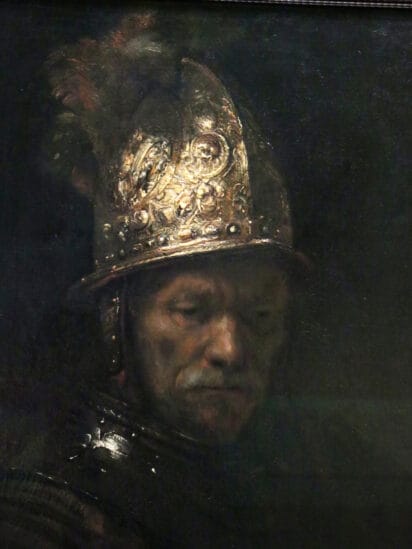

The Gemäldegalerie in Berlin has around 17 Rembrandt paintings — “around” because paintings do get reclassified. The Man with the Golden Helmet was long considered one of the best examples of a Rembrandt painting, but further research led to its reclassification to Rembrandt’s circle. Similarly, the Self-Portrait with a Velvet Beret and Iron Collar is now considered a painting of Rembrandt by someone in his circle (and just maybe Rembrandt painted at least some of it himself).
More exciting is the discovery, or rediscovery, of a Rembrandt. Landscape with Arched Bridge (“Landschaft mit Bogenbrücke”) was attributed to Rembrandt until 1989, when it was re-assigned to Rembrandt’s pupil, Govert Flinck. Three decades later, newer technology allowed this ultra-rare landscape to be re-attributed to Rembrandt himself.
Two Vermeers in Berlin
Only 34 paintings are generally attributed to Johannes Vermeer (1632-1675), with the Gemäldegalerie owning two and displayed in Room 18:

Das Glas Wein (also Herr und Dame beim Wein) / The Wine Glass and Junge Dame mit Perlenhalsband / Woman with a Pearl Necklace.

Jan Steen & Frans Hals

The gallery has several paintings by Jan Steen showing Dutch society at play, drinking, or fighting but the most fun is the “So de Oude songen, so pypen de Jongen” / Wie die Alten singen, so pfeifen die Jungen / As the Old Sing, So the Young Pipe (whistles) (1665-1670).
Jan Steen painted at least 13 versions of this painting, with the Berlin painting quite different from the others. Originally, the painting was more of a merry company in a fine room, but Steen painted out many of the details and made it a lesson in morality. The young will follow the example of the adults — the children on the right are certainly not drinking water, and some boys are most likely smoking in the backyard, or whatever substituted for behind the bicycle sheds in 17th-century Amsterdam.


One of the paintings in the background of the Steen painting is a copy of Malle Babbe / Crazy Bappe (1633), a painting by Frans Hals that is usually displayed nearby, showing the influence of drink. This painting is sometimes referred to as The Witch of Haarlem. However, the owl and the tankard hint at a pub scene and the Dutch saying “as drunk as an owl”. Another background painting shows the bad habit of smoking. Boys singing and playing the flute are more appropriate.
18th-Century European Paintings


Except for Italian painters, the museum’s collection of 18th-century paintings is not of the same standard as the earlier works. A relatively small number of Spanish, French, German, and English paintings are on display in the Gemäldegalerie, but these are of very high artistic quality.
Despite having the largest collection of Spanish paintings in Germany, only a few lesser-known works by famous painters such as Murillo, Zurbarán, and Velázquez (Portrait of a Woman) are shown.
Some German paintings are also displayed here — more from the period are in the Alte Nationalgalerie. Anna Dorothea Therbusch, Selbstbildnis / Self-Portrait (1782), is a large self-portrait posing as a vestal virgin. The special eyeglass always catches the eye.
The Gemäldegalerie’s collection of French paintings is relatively small, but Jean-Baptiste Siméon Chardin, Der Zeichner / The Drawer (1737), is a fine sample. It is one of two very similar versions by Chardin — the second is in the Louvre in Paris.
English Paintings in the Gemäldegalerie Berlin
The Gemäldegalerie has the most extensive collection of English paintings in Germany, but not all are of top quality. Only a few are on display, and several were only acquired in the 1980s to improve the standard of the English collection.

The huge Portrait of John Wilkinson (c. 1775) by Thomas Gainsborough was one of the first notable English works acquired for the collection (in 1904). The modern audience more readily appreciates the equally large Die Marsham-Kinder / Marsham Children (c. 1787), bought in 1982. Reynolds painted faces more idealistically, but that shimmering white satin dress is remarkable.
On to the Italian Baroque and Renaissance Paintings!

How much time do you need to see the Gemäldegalerie in Berlin? If you’ve read this far, at least two hours. At this point, you are the furthest possible from the museum entrance and just over halfway through. To visit the Italian galleries, add another hour (and preferably two, if you have the energy to do it justice). Frustratingly, there is no cafe for a break inside the museum itself!
Even if you are exhausted and suffering from museum fatigue, you have to walk through the Italian galleries anyway to reach the museum exit. Remember to turn around in Hall XIV, or you’ll miss Caravaggio’s Amor Victorious, the single most famous painting in the Gemäldegalerie in Berlin.
→→→ Continue to Italian Highlights in the Gemäldegalerie for more on the fantastic Italian collection in the Paintings Gallery in Berlin.
→See also Tips on Visiting the Gemäldegalerie for visitors’ information, such as tickets and opening hours.
Gemäldegalerie: 200 Masterpieces of European Painting is a beautiful book (but heavy and pricy) — much of the information in the book is available for free when searching the online catalog of the Gemäldegalerie.