Visit the Friedrichswerdersche Kirche in Berlin for an exhibition of the 19th-century German sculptures of the Alte Nationalgalerie.

The brick Neo-Gothic Friedrichswerdersche Kirche in Berlin provides a spectacular setting for the “Ideal and Form” permanent exhibition of 19th-century sculptures by artists associated with the Berliner Bildhauerschule (Berlin school of sculptors). Around 50 works are on display, including marble statues and busts, plaster artist models, and a few bronzes by major German artists, such as Johann Gottfried Schadow, Emil Wolff, Christian Daniel Rauch, Artur Volkmann, and Elisabet Ney. Admission is no longer free. Most visitors spend 30 to 60 minutes — it is not a big museum.
Friedrichswerdersche Kirche: Quick Guide
- Best for: 19th-century sculptures & Schinkel architecture
- Don’t miss: Schadow’s Prussian Princesses
- Time needed: 30–60 minutes
- Combine with: Alte Nationalgalerie & Humboldt Forum
- Location: 5-minute walk from Museum Island and Bebelplatz
- Tickets: €6, also covered by Museum Island Day Ticket, Berlin Welcome Card, Berlin Museum Pass
- Reservations: Not needed
Jump to:
Sculptures · History · Opening Hours · Tickets · Art in Berlin
Ideal and Form: 19th-Century Sculptures from the Nationalgalerie Collection
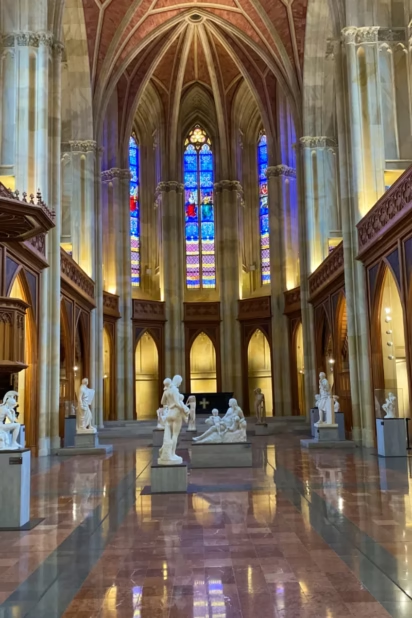
The 50 sculptures on display in the Ideal und Form permanent exhibition in the Friedrichswerdersche Kirche in Berlin are from the unrivaled collection of German sculptures of the Nationalgalerie.
These works are from the long 19th century, i.e., from the French Revolution (1789) to the First World War (1914-1918). In Berlin art historical terms, the period from Schinkel (Schinkelzeit) to the end of the German Empire (Kaiserreich).
The exhibition explains the development of sculpting in the Berlin milieu from the foundation of the first court sculptor school in Germany by Prussian King Frederick the Great in 1747 to the early 20th century and the start of the modern era.
The name Friedrichswerdersche Kirche is rather insignificant — see history below for an explanation. It has been used as an exhibition venue since its reconstruction for the 750th anniversary of Berlin in 1987.
Sculptures in the Friedrichswerdersche Kirche
Top Sculptures to See
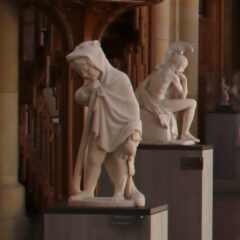
Don’t miss:
- Princesses Luise and Friederike of Prussia by Johann Gottfried Schadow
- Hyacinth by Francois-Joseph Bosio
- Winter by Emil Wolff
- Boy Fishing by Heinrich Kümmel
- Eva with Kain and Abel by Reinhold Begas
- Eva with her children by Adolf Brètt
- Sleeping Shepherd Boy by Adolf von Hildebrand
- Naked Youth (Paris) by Artur Volkmann
The sculptures displayed in the Friedrichswerdersche Kirche are grouped in main themes that include:
Beginning of the Berlin School of Sculptors — the French in Berlin

Frederick the Great was a Francophile in language and thought, so his choices for the first directors of the sculpture school were naturally French artists who introduced the latest techniques of working with marble and bronze to Prussia. The exhibition thus starts with Jean-Pierre Antoine Tassaert’s bronze bust of Moses Mendelssohn and the much-studied bronze Hyacinth by Francois-Joseph Bosio.
Berlin Sculptors in Rome — Between Antiquity and the Modern
Scared off by the chaos of the French Revolution, many artists moved to Rome, which for much of the 19th century was the center of artistic schooling for sculptors. A study of the antiquities was considered essential. Many artists studied in Rome, while some, such as Emil Wolff and Ridolfo Schadow (like the great Danish sculptor Bertel Thorvaldsen), spent almost their entire lives in Rome.
Johann Gottfried Schadow
Johann Gottfried Schadow (1764-1850) was the first highly successful Berlin sculptor of the classical era. Several of his works, as well as some by his son Ridolfo (1786-1822), are on display in the Friedrichswerdersche Kirche in Berlin.
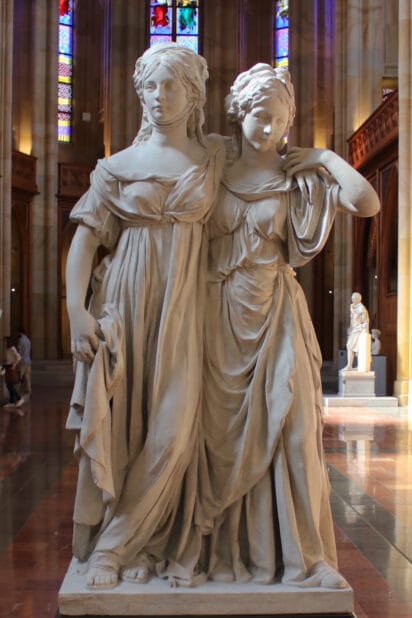
The most praised Schadow sculpture in the exhibition is the plaster working model of Princesses Luise and Friederike of Prussia (Doppelstandbild der Prinzessinnen Luise und Friederike von Preussen).
This original model from 1795 was recently restored. A marble version made in 1797 usually welcomes visitors to the Alte Nationalgalerie on Museum Island.
Schadow’s most famous sculpture in Berlin is, of course, on permanent free display — the Quadriga on top of the Brandenburg Gate.

Other artists with works in the classical style include Katharina Felder, Christian Daniel Rauch, and Christian Friedrich Tieck. Many are figures from mythology and heroes from antiquity, but Heinrich Kümmel’s Fischerknabe (Boy Fishing) was inspired by Goethe’s poem “Der Fischer”.
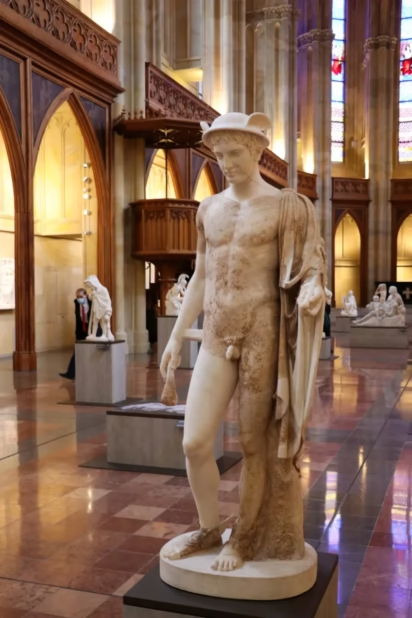
Several works by Emil Wolff are on display. His Hermes (1824) is a restoration of a sculpture from antiquity — a helpful earner for artists trying to make a living in 18th and 19th-century Italy. Of his own marbles, Der Winter (Winter), 1845, is probably the most popular sculpture in the exhibition. It is a boy dressed in a lion skin cloak leaning on a club — two attributes of Hercules — but as an allegory of winter. Winter was already a best-seller in Wolff’s lifetime and sold either as a solo sculpture or as a set of all four seasons.
Export Success — Berlin in England and the USA
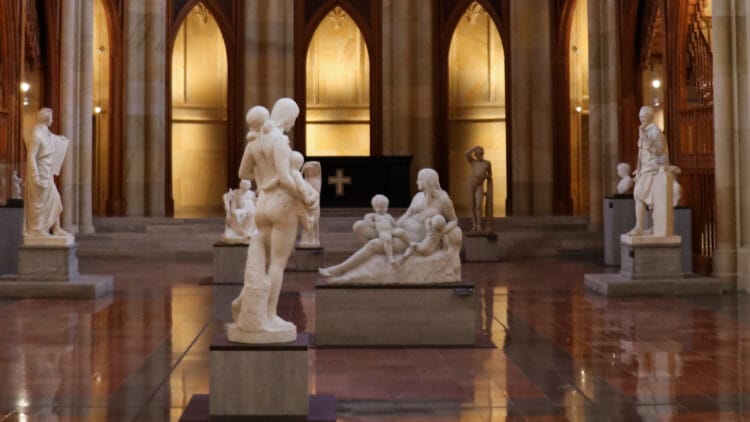
By the mid-century, Prussian sculptors still studied in Italy, but increasingly Renaissance and Baroque sculptures by, amongst others, Michelangelo and Bernini served as inspiration rather than the classics of antiquity. Many Berlin artists successfully sold not only to German patrons but also to England and the USA. German immigrants to the US not only increased the market, but some artists also settled across the Atlantic, including the famous female sculptor Elisabeth Ney — note her Bismarck on the upper level.
Two interesting sculptures showing Eva with her children are by Adolf Brütt and by Reinhold Begas. In the latter, toddler Cain is trying to kick a suckling baby Abel.
Renewal — Berlin, Rome, Paris

Towards the end of the 19th century, German sculptors still studied in Rome, although Paris, especially due to the influence of Rodin, became increasingly popular. Sculptors moved away from classic themes and stylistic portrayals of figures from classical mythology and heroes.
Rather than Hermes, Amor, Achilles, or Hercules, Adolf von Hildebrand sculpted a simple naked Sleeping Shepherd Boy (Schlafender Hirtenknabe) and Paul Peterich a nude boy (Stehender Knabe) — both artists strongly influenced by Renaissance works they studied in Florence. Artur Volkmann moved away from the ideal of a classic white marble sculpture in his Naked Youth (Nackter Jüngling) that is partly painted; due to the apple, he is often described as Paris.
Statues from the Altes Museum in the Friedrichswerdersche Kirche

Several statues originally in the Altes Museum are portrayals of the leading 19th-century artists of the Berlin School, including Rauch, Schadow, and Winckelmann. Three portray Karl Friedrich Schinkel (architect of classical Berlin, including this church and the Altes Museum).
The upper floor is mostly visited for the lovely views from the gallery that goes all the way around the nave. However, there is also an exhibition on the planning of this church, as well as ten further sculptures by artists closely associated with Schinkel, including several by Christian Daniel Rauch, but also by the internationally famous contemporaries such as Bertel Thorvaldsen and Elisabeth Ney.
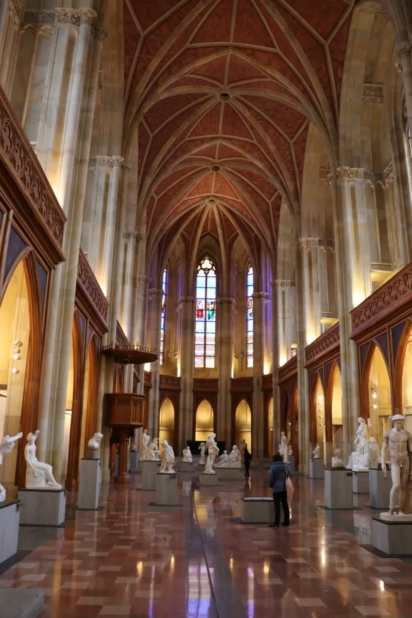
The five stained-glass windows in the choir are the originals from the early 19th century. They were in storage during the final years of the Second World War and restored to the church during the rebuilding in the 1980s.
Friedrichswerdersche Kirche in Berlin

The Friedrichswerdersche Kirche was designed by the famous Prussian architect Karl Friedrich von Schinkel (1781-1841). He designed several neoclassical buildings in Berlin, including the Altes Museum and the Konzerthaus.
Despite Crown Prince Friedrich Wilhelm asking for a church in the medieval style, Von Schinkel presented at least three classical designs before agreeing on the Neo-Gothic design his paymaster wanted. This partly explains the narrow but high proportions and a design that reminds more of English college chapels and classical monuments than German Gothic cathedrals such as the magnificent brick Gothic Minster in Bad Doberan or churches in Lübeck.
The church was erected between 1824 and 1831 — the first prestigious building in brick in Germany since the Middle Ages.
Berlin 750
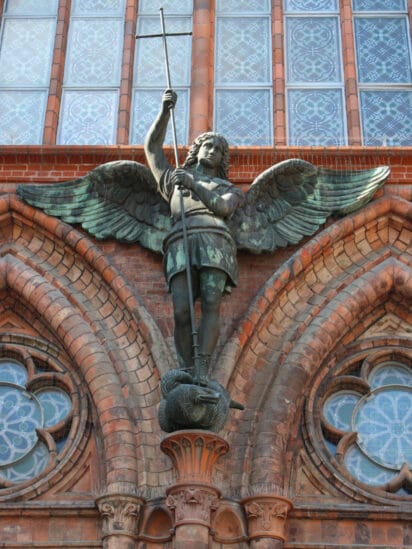
The Friedrichswerdersche Kirche was heavily damaged during the Second World War and left in ruins until it was rebuilt in a rushed job by the East German regime in time for the 750th anniversary of Berlin in 1987. It has been used only as a cultural event space since.
Repairs were necessary between 1997 and 2001, and again after 2012 when nearby construction work caused ground movements that damaged the church. It reopened in 2020.
The repaired church closely followed the plans of Von Schinkel and is the only major building in Berlin with the interior decorated as designed by Von Schinkel. This included painting more complicated vaulting onto the ceiling vaults of the nave to increase the impression of height even further.
The name Friedrichswerdersche Kirche is for many easier to explain than to write or pronounce. Werder is the name of the island that the church is on. The name of the island was changed to Friedrichswerder in honor of the Great Elector Friedrich Wilhelm of Brandenburg (1620-1688). “Sche” is basically the apostrophe “s” to link the church (Kirche) to the island.
Friedrichswerdersche Kirche Visitor Information

Opening Hours and Tickets
The opening hours of the Friedrichswerdersche Kirche are:
- 10:00 to 17:00 from Wednesday to Friday
- 10:00 to 18:00 on Saturday and Sunday
Tickets are €6, which is rather expensive compared to the volume of art displayed in larger state museums. Most visitors spend 30 to 60 minutes.
A much better deal is to use one of the combination tickets, including the Museum Island Day Ticket, 72-h Berlin Welcome Card + Museum Island, or the excellent value 3-day Berlin Museum pass.
Since March 2026, admission is no longer free, except for under-18-year-olds.
No free Sundays or other regular free admission hours.
Currently, it is not necessary or even possible to make time-slot reservations.
More Art Museums Close to the Friedrichswerdersche Kirche
The Friedrichswerdersche Kirche is at Werderscher Markt, a long block behind the Kronprinzenpalais on Unter den Linden and roughly halfway between the Berliner Schloss and Bebelplatz.
The Friedrichswerdersche Kirche at Werderscher Markt is very close to the Humboldt Forum, but combination tickets may make it more sensible to see it on the same day as the other Museum Island museums, including the Alte Nationalgalerie’s exhibition of 19th-century paintings and the sculptures from antiquity in the Altes Museum and Pergamon Museum, or the Middle Ages to Baroque in the Bode Museum.
Where to See Art in Berlin?
The Nationalgalerie Berlin’s vast art collections are displayed in:
| Museum | Best For |
|---|---|
| Gemäldegalerie | German and Dutch Old Masters and Italian paintings |
| Neue Nationalgalerie | Modern, 20th-century art |
| Alte Nationalgalerie | 19th-century paintings |
| Friedrichswerdersche Kirche | 19th-century sculpture |
| Bode Museum | Medieval to 18th-century sculptures and paintings |
| Hamburger Bahnhof | Contemporary art |
Save with multi-museum day passes (Kulturforum / Museums Island), Berlin Welcome Cards, or the 3-day Berlin Museum Pass.
→ Archive of all Berlin State Museums posts on European Traveler.
Berlin State Museums (Staatliche Museen zu Berlin):
- Brief Overview of the National Museums and Galleries in Berlin
- Berlin State Museums: What Is Seen Where?
- Opening Hours (2026) — closed on Monday, some on Tuesday too.
- Ticket Prices for Berlin State Museums — buy online and go directly to the entrance.
- Staatliche Museen zu Berlin (official website in German & English).
→ Archive of all Berlin State Museums posts on European Traveler.