Visit Neo-Gothic Schloss Hohenschwangau, the childhood home of King Ludwig II of Bavaria, whose romantic upbringing helped inspire the nearby Disney-like Neuschwanstein Castle.

The fairy-tale Schloss Neuschwanstein is the must-see destination for most visitors to Schwangau near Munich in Bavaria. Far fewer travelers see the nearby Neo-Gothic Schloss Hohenschwangau, where Mad King Ludwig spent happy childhood summers and probably dreamed up plans for his own more elaborate fantasy castles. Schloss Hohenschwangau was erected during the 1830s by Bavarian King Maximilian II in a Neo-Gothic style and remains under the control of the royal Wittelsbach family. Time-slot tickets are required, but advance reservations are usually necessary only in the high season.
Schwangau and the Allgäu Became Part of Bavaria
Following the Napoleonic Wars, Bavaria increased its territory, including the beautiful Allgäu area. In these new territories, Bavarian Crown Prince Maximilian discovered the ruins of Schloss Hohenschwangau.
Maximilian loved the natural beauty of the Allgäu region. The Alps formed a natural border with Austria, and the future king enjoyed hunting here as well as the marvelous views from the mountains of the now Bavarian Lech Valley. The ruins of Hohenschwangau near the small Alpsee Lake offered a perfect location for Maximilian’s fantasy castle.
Schloss Hohenschwangau Castle near Füssen
In the 1830s, Maximilian II built the new Neo-Gothic castle on the ruins of the historic Schloss Hohenschwangau. Domenico Quaglio used his skill as both an architect and a theater designer to create a theatrical fantasy in a fully functional building. (Ludwig II’s Neuschwanstein, in contrast, remained a rather unusable fantasy castle.)
Romantic wall paintings of German sagas dominate the interior of Schloss Hohenschwangau. Schwan is German for swan, and swans are often used in decorations to link the new castle to the heraldic symbols of the medieval county of Schwangau.
Several paintings are dedicated to the Swan Order. Its most illustrious knight, Lohengrin, was later to inspire one of the best-known operas by Richard Wagner. The later King Ludwig II was a great admirer of Wagner, whom he met for the first time in Hohenschwangau.
King Maximilian of Bavaria at Schloss Hohenschwangau
Bavarian King Maximilian II and his wife, Princess Marie of Prussia, used Schloss Hohenschwangau mostly as a summer residence. They basically initiated the era of mass tourism for the Schwangau region. Just as day-trippers now provide work for locals, the court following the monarch provided a major economic stimulus during the nineteenth century.
Maximilian and Marie loved to entertain and frequently had receptions in the massive Knights’ Hall in Schloss Hohenschwangau. Their son, the later “Mad” King Ludwig II, in contrast, was more asocial. The large Singers’ Hall, with impressive acoustics, in his fantasy Neuschwanstein Castle was used for concerts for the first time only sixty years after his death.
Mad King Ludwig II at Schloss Hohenschwangau
As prince, Ludwig spent many happy childhood summers at Schloss Hohenschwangau. His romantic disposition was no doubt greatly influenced by the paintings he saw on the walls of his family’s summer residence.
The best-known result of Ludwig’s childhood at Hohenschwangau is the nearby Disney-like Neuschwanstein Castle, which he built within easy walking distance.
Visit Schloss Hohenschwangau Castle
Guided tours require timed-entry tickets. Current prices, opening hours, and online reservations are available on the official ticket website. Hohenschwangau is open daily, except for a few days over Christmas and New Year.
Schloss Hohenschwangau is far less popular with visitors than the nearby Schloss Neuschwanstein. As a result, Hohenschwangau may often be seen without advanced ticket reservations, but on busy days it is €2.50 well spent to book a time slot in advance.
Buy tickets online or at the Ticket Center, on the main road in Hohenschwangau near the bus stop for buses from Füssen. From here, it is a ten-minute hike with some stairs over a slight hill to Schloss Hohenschwangau. A level route is also available, taking around 20 minutes.
- See Tickets for Schloss Neuschwanstein and Schloss Hohenschwangau for more visitor information, opening hours, and tickets.
On busy days, a horse-drawn wagon goes from just below the Ticket Center to Schloss Hohenschwangau in around 20 minutes.
Some courtyards and parts of the garden are open to visitors without tickets. These are worth exploring, even if not planning to tour the castle interior.
As Hohenschwangau is not a state property, it is not included in the Bavarian sightseeing savings ticket deals.
Both Schloss Hohenschwangau and Neuschwanstein Castle are in Schwangau near Füssen, an easy and popular day-trip destination by public transportation from Munich. Many day-trip tours are also available from Munich.
Visit King Ludwig’s Castles and Palaces near Munich
King Ludwig II’s three famous palaces are among Bavaria’s top attractions and popular day trips from Munich. Each offers a very different experience — from the fairy-tale towers of Neuschwanstein to the intimate luxury of Linderhof and the Versailles-inspired grandeur of Herrenchiemsee. Since their inscription as UNESCO World Heritage Sites in 2025, they have become even more popular day-trip destinations from Munich.
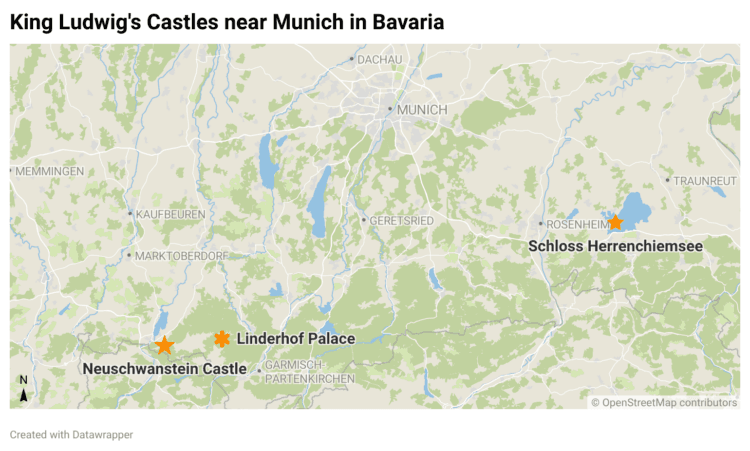
Use the guides below to choose which palace to visit, check tickets and transportation, or book a guided tour from Munich.
→ ⭐ Not sure which castle to visit? Compare King Ludwig’s three palaces here.
Plan Your Visit
- Which of King Ludwig’s Fantasy Castles Should You Visit Near Munich?
- Best Sightseeing Saving Passes in Munich and Bavaria
- Save with the Bayern Ticket on Public Transportation — Buy the Bayern Ticket Online.
- Book Day-Trip Tours from Munich
Schloss Neuschwanstein and Schloss Hohenschwangau
Fairy-tale castles near Füssen with timed-entry tickets that often sell out.
- Tickets for Neuschwanstein and Hohenschwangau
- Transportation to Schloss Neuschwanstein
- Why Visit Schloss Neuschwanstein?
- Why Visit Schloss Hohenschwangau?
- What to See in Nearby Füssen and Schwangau
- Neuschwanstein Day-Trip Tours
Linderhof Palace and Park
King Ludwig’s only completed palace, famous for its lavish interiors and landscaped gardens.
- Why Visit Schloss Linderhof?
- Linderhof Visitor Guide: Opening Hours, Tickets, and Transportation
- Day-Trip Tours to Linderhof
Schloss Herrenchiemsee
A Versailles-inspired palace on a peaceful island in Lake Chiemsee.
- Herrenchiemsee Visitor Guide: Sights, Opening Hours & Tickets
- Why Visit Schloss Herrenchiemsee?
- Transportation to Schloss Herrenchiemsee
- Book Day-Trips from Munich to Herrenchiemsee