Schloss Herrenchiemsee Palace on Herreninsel in Lake Chiemsee near Munich is an opulent Versailles-inspired fantasy palace built by Bavarian King Ludwig II.

King Ludwig II of Bavaria, often called the Fairy Tale King, is famous for the three fantasy castles he erected in his kingdom near Munich during the nineteenth century. The most popular is the Disney-like, neo-Romanesque Schloss Neuschwanstein Castle, while the small Schloss Linderhof is the only palace he actually completed. However, with Schloss Herrenchiemsee, he planned to surpass all others. Herrenchiemsee was to be King Ludwig’s Versailles, complete with a Hall of Mirrors longer than the original in France. The palace, beautifully located on an island in a lake, is a popular day-trip destination from Munich.
This article focuses on what to see inside Schloss Herrenchiemsee and the history of King Ludwig II’s Versailles-inspired palace. For practical visitor information, tickets, opening hours, and transport, see Visiting Herrenchiemsee Palace and Transportation to Herrenchiemsee.
Building of the Neues Schloss Herrenchiemsee

© saiko3p / Depositphotos
Ludwig II, King of Bavaria from 1864 to 1886, is fondly remembered for his romantic disposition and fantasy castles.
In 1873, he bought Herreninsel, the largest island in the Chiemsee, a large lake halfway between Munich and Salzburg. His explicit aim was to replicate the best of Versailles in his own, private new palace.
Georg Dollman mostly drew up the plans for a huge palace while Carl von Effner designed splendid Baroque gardens.
Construction started in 1878, but by the time of King Ludwig’s mysterious death in 1886, only twenty rooms were completed. These twenty rooms alone were more expensive than both Ludwig’s other two follies, Neuschwanstein Castle and Linderhof Palace.
The plan was never to copy the entire Château de Versailles but to replicate some of the state rooms from the time of the Sun King Louis XIV and the concept of the formal gardens.
Touring the Neues Schloss Herrenchiemsee Palace
The interior of the Neues Schloss (New Palace) Herrenchiemsee may only be seen on a guided tour (ca. 35 minutes). (See Visiting Herrenchiemsee Palace on how to buy tickets.)
Highlights of the tour include the monumental staircase inspired by the Doge’s Palace in Venice and the Great Hall of Mirrors, which at 98 m (322 ft) is slightly longer than the original at Versailles.
King Ludwig was somewhat eccentric: he valued his privacy to the extent that he had his dining table hoisted, fully decked, from a floor below so he could eat without servants hovering about. He used a similar table at Linderhof Palace, where he actually resided for long periods.
His desire for privacy did not prevent the construction of a state bed chamber like the one the French Sun King Louis XIV used for going to bed in a public ceremony. This show bedroom, more lavish and larger than the original, was the first room completed in the palace. Ludwig never actually slept here, although even the famously tall king would have felt small in the massive bed measuring 2.6 by 3 m (8.5 by 9.8 ft).
It is easy to see why the building of this palace bankrupted the king. He left no surface ungilded or unadorned. The Meissen porcelain used in the construction of the elaborate candelabras remained unique – the king insisted on all molds being broken to ensure that no copies could be made.
The guided tour visits all completed rooms, but 35 minutes really is too rushed to appreciate all the fine detail in the exquisite and carefully planned decorations.
Mad or Fairy-Tale King Ludwig?
Ludwig II (ruled 1864-1886), or Louis the Second, is sometimes referred to in English as “Mad King Ludwig” — not so much for his fantasy castles, but because he was declared insane by the Bavarian authorities days before his mysterious death in 1886. In German, the Märchenkönig (Fairy-Tale King) is more common.
Ludwig II became somewhat obsessed with his namesake, Louis XIV, and Herrenchiemsee is largely a tribute to the Sun King. Somewhat ironically, Ludwig is not named after the French despot but rather after his grandfather, Bavarian King Ludwig I (ruled 1825-1848), who was named after French King Louis IX, also known as Saint Louis and the builder of the magnificent Sainte-Chapelle in Paris.
Ludwig I was also an art lover and builder. Among his legacy are the Glyptothek and Alte Pinakothek in Munich — two major powerhouses of European art.
King Ludwig II Museum at Schloss Herrenchiemsee
The König Ludwig II.-Museum is in the south wing of Schloss Herrenchiemsee Palace. It is included in all tickets and is seen without a tour. The museum is a good place to wait for the commencement of the guided tour of the palace itself. (The palace café with an outdoor terrace in summer is not a bad choice for lingering in either.)
The museum has numerous displays and furniture related to the life of King Ludwig II, his fantasies, opera sets, as well as his friendship with composer Richard Wagner. Note the displays related to the planned Burg Falkenstein Castle – it would have made even Schloss Neuschwanstein look unambitious.
The gardens are freely accessible. They were inspired by Versailles with a parterre d’eau and grand canal. The impressive fountains play frequently from early May to early October.
Despite its island location, good transportation links and long opening hours make Schloss Herrenchiemsee Palace easy to visit on day trips from Munich, Berchtesgaden, and Salzburg. Day-trip excursion tours are sometimes available from Munich.
Visit King Ludwig’s Castles and Palaces near Munich
King Ludwig II’s three famous palaces are among Bavaria’s top attractions and popular day trips from Munich. Each offers a very different experience — from the fairy-tale towers of Neuschwanstein to the intimate luxury of Linderhof and the Versailles-inspired grandeur of Herrenchiemsee. Since their inscription as UNESCO World Heritage Sites in 2025, they have become even more popular day-trip destinations from Munich.
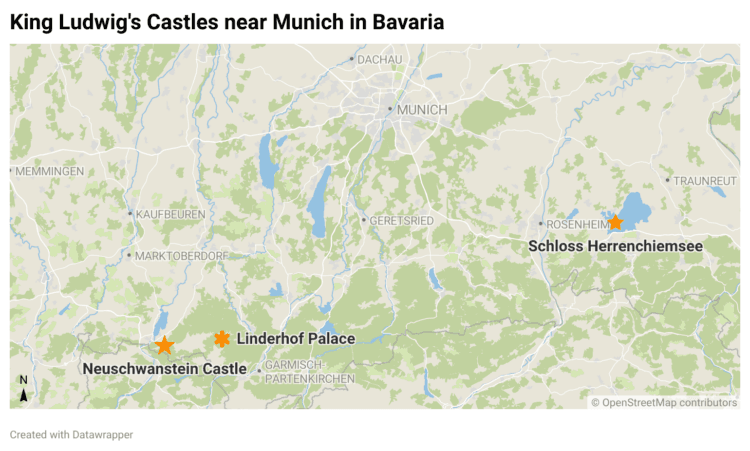
Use the guides below to choose which palace to visit, check tickets and transportation, or book a guided tour from Munich.
→ ⭐ Not sure which castle to visit? Compare King Ludwig’s three palaces here.
Plan Your Visit
- Which of King Ludwig’s Fantasy Castles Should You Visit Near Munich?
- Best Sightseeing Saving Passes in Munich and Bavaria
- Save with the Bayern Ticket on Public Transportation — Buy the Bayern Ticket Online.
- Book Day-Trip Tours from Munich
Schloss Neuschwanstein and Schloss Hohenschwangau
Fairy-tale castles near Füssen with timed-entry tickets that often sell out.
- Tickets for Neuschwanstein and Hohenschwangau
- Transportation to Schloss Neuschwanstein
- Why Visit Schloss Neuschwanstein?
- Why Visit Schloss Hohenschwangau?
- What to See in Nearby Füssen and Schwangau
- Neuschwanstein Day-Trip Tours
Linderhof Palace and Park
King Ludwig’s only completed palace, famous for its lavish interiors and landscaped gardens.
- Why Visit Schloss Linderhof?
- Linderhof Visitor Guide: Opening Hours, Tickets, and Transportation
- Day-Trip Tours to Linderhof
Schloss Herrenchiemsee
A Versailles-inspired palace on a peaceful island in Lake Chiemsee.
- Herrenchiemsee Visitor Guide: Sights, Opening Hours & Tickets
- Why Visit Schloss Herrenchiemsee?
- Transportation to Schloss Herrenchiemsee
- Book Day-Trips from Munich to Herrenchiemsee