Visit the Mies van der Rohe-designed Neue Nationalgalerie (New National Gallery) in Berlin to see modern, 20th-century art exhibitions.
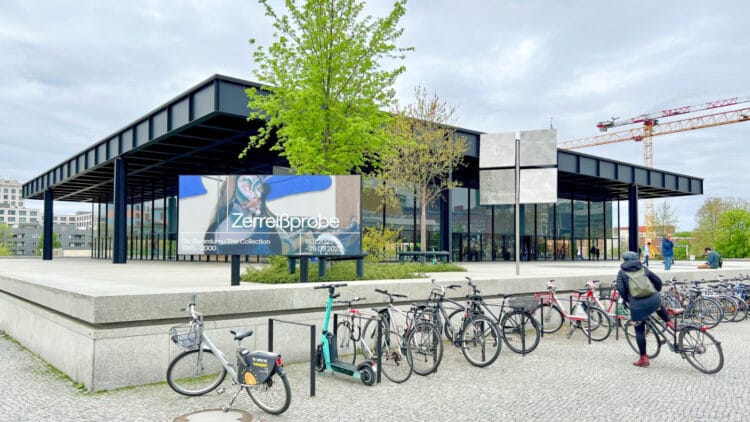
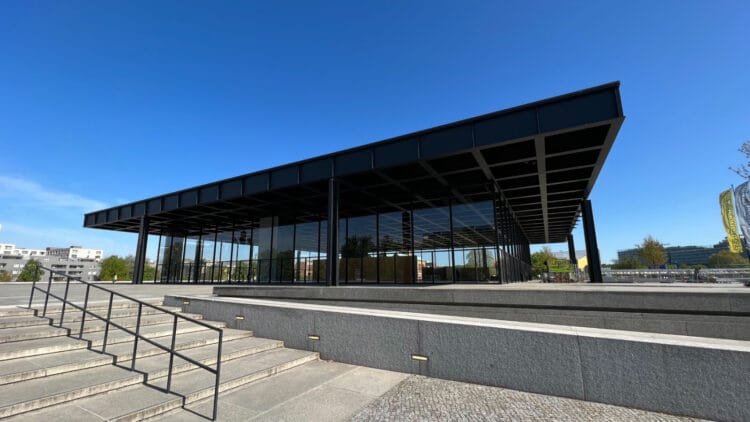
The Neue Nationalgalerie in the Kulturforum area is home to Berlin’s vast collection of 20th-century modern art. This architectural masterpiece by Mies van der Rohe is an interesting venue for displaying modern art. The huge glass-walled main floor is mostly used for major temporary art exhibitions by internationally famous artists. The Nationalgalerie’s own works are displayed in thematic exhibitions that rotate every couple of years. Many further, smaller temporary exhibitions are held several times per year. The Nationalgalerie will be able to permanently showcase the full range of its collection only on completion of the adjacent new Berlin Moderne museum in the 2030s. Buy skip-the-line tickets online in advance — time-slot reservations are often required to visit the Neue Nationalgalerie.
Neue Nationalgalerie in Berlin: Quick Guide
📍 Location: Kulturforum, Berlin
⭐ Don’t Miss:
- Mies van der Rohe’s Bauhaus masterpiece
- Gerhard Richter. 100 Works for Berlin
- Major international art exhibitions in Berlin’s most iconic museum building
⏱ Time Needed:
At least an hour for the highlights; add 30 minutes for special exhibitions
🎟 Best Ticket:
Kulturforum Day Ticket if visiting more than one museum.
📅 Best Time to Visit:
Weekdays at 10:00 or after 15:00
📷 Photography:
No-flash photography for private use is allowed; many works are still under copyright protection.
🎨 Good For:
20th-century German, European, and Western art — one of the world’s top modern art collections.
Why Visit? Berlin’s best museum for modern art, including paintings, sculptures, and audio-visual art from mostly German, European, and American artists.
Mies van der Rohe’s Neue Nationalgalerie
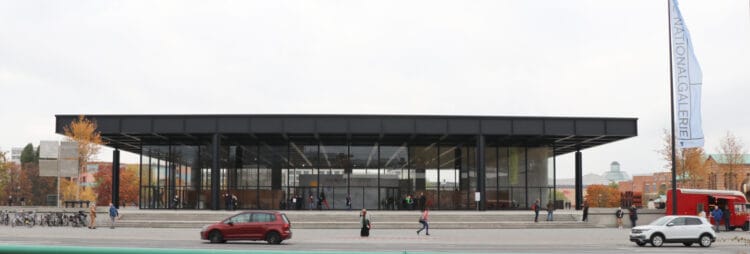
The Neue Nationalgalerie in Berlin’s Kulturforum near Potsdamer Platz and the Berliner Philharmonie was the final stand-alone project of former Bauhaus director and 20th-century star architect Mies van der Rohe (1886-1969). It was built between 1965 and 1968 and restored by David Chipperfield Architects from 2015 to 2021.
The restoration followed the principle of “as much Mies as possible”. Many original fittings — around 35,000 components in total — were cleaned up, restored, and reused. The building is already a national monument, requiring that strict conservation principles be followed.
Kulturforum Museums
See at the Kulturforum in Berlin:
- Gemäldegalerie — German and Dutch Old Masters and Italian paintings.
- Kunstgewerbemuseum — Decorative Arts.
- Musical Instruments Museum near the Berliner Philharmonie.
- Neue Nationalgalerie — 20th-century art.
- Berlin Modern — 20th-century art (opening around 2030).
Visit the Neue Nationalgalerie in Berlin

The name Neue Nationalgalerie (New National Gallery) refers to the building — it is in addition to the Alte Nationalgalerie, a neoclassical museum building reminiscent of a Greek temple on Museum Island.
The new gallery was erected in the 1960s as the core of the new Kulturforum (Cultural Forum) in West Berlin. At this stage, Berlin’s traditional museums on Museum Island were in the East, although much of the art collection was physically in the western parts of the city after the war.
Why visit the Neue Nationalgalerie?
The Neue Nationalgalerie is famous for its architecture — it is the only building in the city by Bauhaus star architect Mies van der Rohe. It is used for major temporary exhibitions, which benefit from Germany’s most important collection of 20th-century art.
The vast art collection of the Nationalgalerie and State Museums of Berlin is displayed in several museum buildings. Modern art, ca. 1900 to 1970, is in the Neue Nationalgalerie. For newer, contemporary art in Berlin, visit the Hamburger Bahnhof. See 19th-century art in the Alte Nationalgalerie and the fantastic collection of old masters in the nearby Gemäldegalerie.
Two further smaller museums near Schloss Charlottenburg have two special 20th-century art displays:
- Museum Berggruen Collection: a small but exquisite collection of classic modern art, including works by Picasso (120), Paul Klee (70), Matisse, and Giacometti.
- Collection Scharf-Gerstenberg: art of the fantastic and the art of Surrealism.
Where to See Art in Berlin?
The Nationalgalerie Berlin’s vast art collections are displayed in:
| Museum | Best For |
|---|---|
| Gemäldegalerie | German and Dutch Old Masters and Italian paintings |
| Neue Nationalgalerie | Modern, 20th-century art |
| Alte Nationalgalerie | 19th-century paintings |
| Friedrichswerdersche Kirche | 19th-century sculpture |
| Bode Museum | Medieval to 18th-century sculptures and paintings |
| Hamburger Bahnhof | Contemporary art |
Save with multi-museum day passes (Kulturforum / Museums Island), Berlin Welcome Cards, or the 3-day Berlin Museum Pass.
→ Archive of all Berlin State Museums posts on European Traveler.
Main Exhibitions in the Neue Nationalgalerie in Berlin

The Neue Nationalgalerie currently has no traditional permanent exhibition. Instead, its collection is shown in large, long-term displays that normally remain unchanged for several years. These are shown in the main exhibition area on the museum’s lower level.
Since the reopening of the Neue Nationalgalerie in 2021, it has had two major long-running exhibitions from its permanent collection:
- The Art of Society / Die Kunst der Gesellschaft, 1900-1945 (2021-2023)
- Zerreißprobe. Art Between Politics and Society, 1945 and 1985 (2023 to 2027)
Zerreißprobe. Art Between Politics and Society: The Collection Between 1945 and 1985
A special exhibition of the Nationalgalerie Sammlung from November 2023 to April 2027

The Zerreißprobe. Kunst zwischen Politik und Gesellschaft. Die Sammlung 1945 – 1985. The exhibition period was extended by nearly two years until 25 April 2027.)
Hardly any other era in Germany was so marked by division, rupture, and transformation as the time after the Second World War. In light of this, the Neue Nationalgalerie is very deliberately showing its new collection display of post-1945 art under the title Zerreißprobe (stress test). Taking the radical performance of the same title by Günter Brus as its point of departure, the Neue Nationalgalerie shows how dramatically post-war art was shaped by the tensions that existed between politics and society.
The presentation features key works from West and East Germany, Western Europe, and the USA, and unpacks central artistic and societal themes from the 20th century, such as issues related to realism and abstraction, politics and society, everyday life and pop culture, feminism, and nature and ecology.
On display are works from the Art Informel movement and American Colour Field painting, from Pop Art and Minimalism, as well as works of figures such as Josef Albers, Joseph Beuys, Francis Bacon, Lee Bontecou, Rebecca Horn, Valie Export, Bruce Naumann, Wolfgang Mattheuer, Louise Nevelson, Gerhard Richter, Bridget Riley, and Willi Sitte.
Die Kunst der Gesellschaft / Art of Society, 1900-1945
A special exhibition of the Nationalgalerie Sammlung from August 22, 2021, to July 2, 2023.

The main exhibition at the re-opening of the Neue Nationalgalerie was Art of Society, 1900-1945, which ran for two years. Around 250 artworks covered this very turbulent period in the history of Germany and particularly Berlin.
Political events and changes in society in Germany happened fast and cut deep in the first half of the twentieth century. The period opens with attempts to reform the autocratic German Empire but the consequences of the First World War were the abrupt end of the monarchy, several failed (often violent) revolution and insurrection attempts in Germany (and especially in Berlin), hyperinflation, and the ultraliberal Weimar Republic. The Roaring Twenties were followed by financial collapse, the rise of National Socialism, and finally the disaster of the Second World War and the immediate consequences such as the holocaust, refugees, displacement, and Germany in ruins.
The Nationalgalerie owns around 1800 works covering the period 1900 to 1945. The artists’ list for Die Kunst der Gesellschaft exhibition in the Neue Nationalgalerie reads like a who’s who of early 20th-century German and European artists and is a good indication of what may follow once the Berlin Moderne opens. Artists included amongst others Hans Arp, Max Beckmann, Rudolf Belling, Otto Dix, Max Ernst, Lyonel Feininger, Alberto Giacometti, George Grosz, Hannah Höch, Wassily Kandinsky, Ernst Ludwig Kirchner, Paul Klee, Hilma af Klint, Oskar Kokoschka, Käthe Kollwitz, Lotte Laserstein, René Magritte, Franz Marc, Paula Modersohn-Becker, George Muche, Otto Mueller, Edvard Munch, Emil Nolde, Max Pechstein, Pablo Picasso, Curt Queren, Hans Richter, Christian Schad, Oskar Schlemmer, Karl Schmidt-Rottluff, Renée Sintenis, Irma Stern, Heinrich Vogeler, and Jenny Wiegmann.
Special Temporary Exhibitions at the Neue Nationalgalerie in Berlin
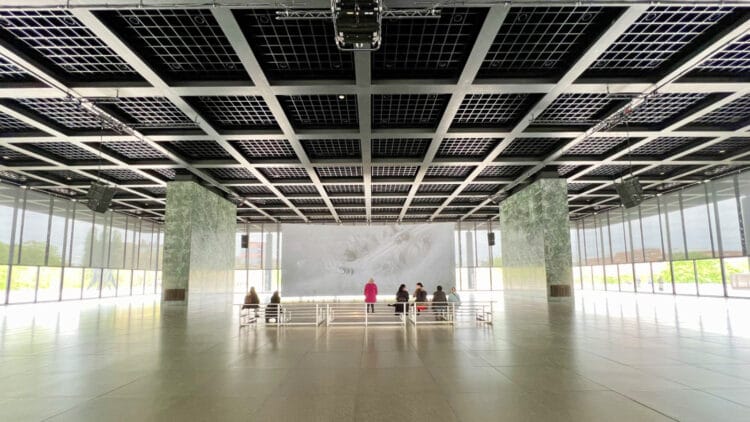
The Neue Nationalgalerie in Berlin hosts several temporary and special exhibitions every year.
The “glass box”, the main ground floor of the museum, which is surrounded by large, clear windows, is the most prestigious venue for major art exhibitions in Berlin, sometimes including live performances. These exhibitions often add a surcharge to other museum tickets, but are optional and may usually be seen separately from the main exhibitions too.
On the lower floor are further spaces for several concurrent temporary exhibitions. Admission to these is often included in the general museum ticket, but larger exhibitions may sometimes also be seen separately on a cheaper ticket.
Gerhadt Richter (b. 1932) is Germany’s most famous living visual artist. The Neue Nationalgalerie has organized Richter exhibitions since its reopening in 2021, with the current ongoing exhibition “100 Works for Berlin” showing art from his oeuvre spanning six decades.
Where to See European Art in Berlin State Museums
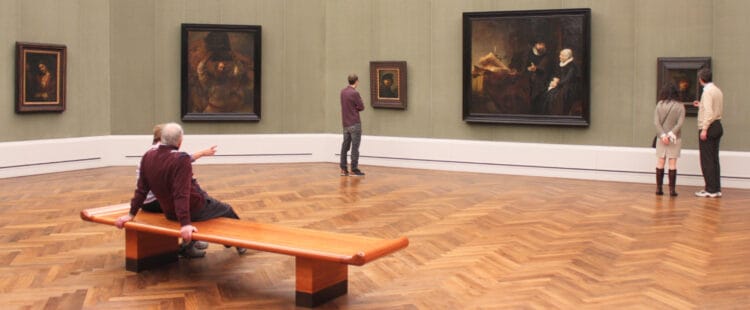
The basic division of the massive, mostly European art collection of the Staatliche Museen zu Berlin is currently as follows:
| Collections | Museum | Highlights |
|---|---|---|
| Paintings (Middle Ages to 18th century, especially German, Dutch, Flemish, Italian) | Gemäldegalerie (Kulturforum) | Amor Triumphant by Caravaggio, The Wine Glass by Vermeer Works by Rembrandt (16), Cranach (22), Dürer (7), Van Eyck (3) |
| Sculpture Collection (Middle Ages to 18th century) | Bode Museum (Museum Island) | Riemenschneider woodcarvings, Gothic altars, Italian sculptures (incl. Donatello), Byzantine art |
| National Gallery (19th-century art) | Alte Nationalgalerie (Museum Island) | Monk by the Sea and Abbey Among Oak Trees (Caspar David Friedrich), Im Wintergarten (Manet), Rodin sculptures. |
| National Gallery (19th-century sculptures) | Friedrichswerdersche Kirche | Prussian Princesses (Schadow) |
| National Gallery (20th-century art) | Neue Nationalgalerie (Kulturforum) | Gerhardt Richter, Major temporary exhibitions |
| National Gallery (20th-century art) | Berlin Modern (Kulturforum) | Due to open in the early 2030s |
| National Gallery Berlin Contemporary | Hamburger Bahnhof | Joseph Beuys, Major temporary exhibitions |
- See also Berlin State Museum Collections Explained: What is Seen Where? for a fuller guide to Berlin’s vast museum exhibitions and magnificent art galleries.
Neue Nationalgalerie Berlin Visitor Information
Tickets for the Neue Nationalgalerie
Tickets for the Neue Nationalgalerie are €14 and include the main and some smaller temporary exhibitions. Time-slot reservations are sometimes used for special exhibitions.
For most visitors, buying a Neue Nationalgalerie ticket online is the easiest option and avoids ticket office queues. If planning to visit another venue on the same day, the Kulturforum Day Ticket is a good savings option.
Depending on the scale of the temporary exhibitions, a surcharge of up to €6 is sometimes added to all tickets. Visiting (and paying) for temporary exhibitions at the Neue Nationalgalerie is almost always optional.
Admission is free for under-18-year-olds.
Currently, admission is free for all on the first Thursday of the month for entry after 16:00.
The Berlin Museum Pass (excellent value at €32 for three days) and several other discount passes may be used. However, for the museum pass, an upgrade ticket (€6, available on-site) is required for some exhibitions.
Why the Kulturforum Day Ticket Is Good Value
The €22 Kulturforum day ticket is cheaper than visiting two museums individually and gives access to Berlin’s best art collections:
- Gemäldegalerie — one of the world’s greatest collections of old master paintings.
- Neue Nationalgalerie — 20th-century art displayed in a Mies van der Rohe masterpiece.
- Kunstgewerbemuseum — decorative arts and design.
- Special exhibitions by the Museum of Prints and Drawings and the Art Library.
- Musical Instruments — 800 historic instruments; try visiting when the Mighty Wurlitzer theater organ is played.
Most visitors easily see two museums in a day, making the pass good value.
Opening Hours of the Neue Nationalgalerie in Berlin
The opening hours of the Neue Nationalgalerie are Tuesday to Sunday from 10:00 to 18:00, closing at 20:00 on Thursday.
It is the only Kulturforum museum with longer hours on Thursday. These evenings are good times to visit, except on the first Thursday of the month, when admission is free from 16:00; it can get very busy, but a lively cultural program is often added.
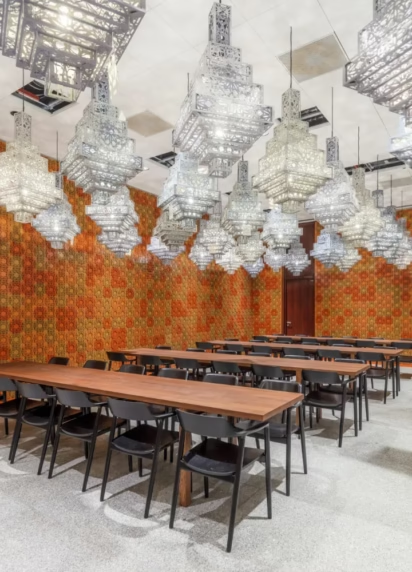
The sculpture garden, bookshop, and cafe are all worth visiting too. Jorge Pardo’s room-sized, site-specific installation for Berlin’s Neue Nationalgalerie’s café, comprises a suite of hanging light sculptures and a floor-to-ceiling array of warmly toned wall tiles.
Transportation to Visit the Neue Nationalgalerie in Berlin
The Neue Nationalgalerie is part of the large Kulturforum neighborhood to the west of Potsdamer Platz. The buses stop very close to the museum, while walking from the U and S Bahn train stations is often faster than waiting for the bus.
Convenient buses (closest stop) include Bus M29, 200, M85, and M48 (Potsdamer Brücke) and 200, 300, M41 (Philharmonie). U-Bahn 2 stops at Potsdamer Platz, as do various S-trains, including S1 and S2, and the new Berlin Airport Express (FEX) trains.
News & Temporary Exhibitions in Berlin in 2026:
- 2026: Top Special Art Exhibitions at Kulturforum and Special Museumsinsel Exhibitions (Alte Nationalgalerie).
- Museums Closed in 2026:
- The Pergamon Museum (until mid-2027); Das Panorama is open.
- The Museum Berggruen(much of its collection is traveling the world)
- The permanent collection of the German History Museum (Zeughaus); temporary exhibitions continue in the Pei Building.
- 2027: Reopening of the Pergamon Museum with the Pergamon Altar (4 June 2027), reopening of the Museum Berggruen
- 2030s: Berlin Modern to share the Museum of 20th-Century Art with the Neue Nationalgalerie on Kulturforum.
More on the Berlin State Museums (Staatliche Museen zu Berlin):
Berlin State Museum Basics:
- Top National Museums and Galleries (brief overview)
- Berlin State Museums: What Is Seen Where?
- Opening Hours (2026)
- News & Special Exhibitions
- Ticket Prices (Buy online from GetYourGuide or SMB)
- Save with the Berlin Museum Pass & Berlin Welcome Cards
- Staatliche Museen zu Berlin (official website in German & English)