Schloss Linderhof is the smallest and only completed palace of King Ludwig II of Bavaria. Set in an elaborate park near Oberammergau, it is famous for its lavish Rococo interiors, fountains, and spectacular Venus Grotto.

Schloss Linderhof is the smallest of the opulent palaces and castles built by Bavarian Mad King Ludwig II. It is the only one of his fantasy castles that was mostly completed at the time of his mysterious death in 1886. Linderhof was King Ludwig II’s favorite residence and the only palace where he lived for extended periods. The more famous Disney-like Schloss Neuschwanstein Castle and Versailles-inspired Herrenchiemsee Palace remained unfinished. All three palaces are popular day trips from Munich, UNESCO-listed heritage sites, and worth visiting.
- This article is mostly about the history and architecture of Linderhof Palace. See Visit Schloss Linderhof: Opening Hours, Tickets, and Transportation for visitor information.
Schloss Linderhof Palace in the Ammer Valley, Bavaria
Linderhof Palace’s origins were a more modest hunting lodge in the Ammer Valley. During the 1860s, Bavarian King Ludwig II (1864-1886) started remodeling the lodge. As was common with Ludwig II, he frequently changed his mind and altered his building plans. In the end, Ludwig moved the lodge deeper into the park and built the small but opulent Schloss Linderhof Palace instead.
In contrast to King Ludwig’s other palaces, Linderhof was mostly completed by 1876 but he continued to add features up to his death ten years later.
Schloss Linderhof has a relatively modest floor plan measuring only 30 x 27 m (98 x 88 feet). In comparison, the Hall of Mirrors in Schloss Herrenchiemsee, King Ludwig’s Bavarian copy of Versailles, is 75 m (246 ft) long.
The Renaissance, Baroque, and Rococo-style features of Linderhof Palace blend fairly harmoniously. The interior is very opulent with rich gilding and no square inch unadorned.
Ludwig II, or Louis the Second, is sometimes referred to in English as “Mad King Ludwig” — not so much for his fantasy castles, but because he was declared insane by the Bavarian authorities days before his mysterious death in 1886. In German, the Märchenkönig (Fairy Tale King) is more common.
Schloss Linderhof Park Gardens

King Ludwig II once harbored dreams of creating a Versailles-like park at Linderhof. However, the Ammer Valley was simply too narrow to accommodate such grand gardens, so Ludwig transferred this project to Schloss Herrenchiemsee, his most spectacular palace. (Neither palace nor gardens were completed at Herrenchiemsee.)
As a result, the park at Linderhof remains much more modest. In front of the palace is a large formal pool where a fountain spews water up to 22 m (72 ft) high. Note the large 300-year-old lime tree that Ludwig left in place despite its effect on the symmetry of the formal gardens. The Venus temple at the far side of this pool gives the best views of Schloss Linderhof.
The park has several further structures bought by or associated with King Ludwig II. These garden structures are mostly open in the summer only.
- The Venus Grotto (Venusgrotto) at Schloss Linderhof is an artificial cave inspired by the first act of Wagner’s opera Tannhäuser. (Reopened in 2025 after renovations and now requiring separate reservations, available online or at the palace ticket center.)
- The Moorish Pavilion (Maurischer Kiosk) was bought at the 1867 Paris World Fair by King Ludwig for the park at Schloss Linderhof. (The pavilion is closed for renovation work until at least 2028.)
- The Moroccan House (Marokkanisches Haus) was bought by Ludwig II at the 1878 Paris World Fair but was only erected at Linderhof Park in 1998.
Admission to the park and smaller structures is free. Large parts of the park are suitable for wheelchairs and strollers, but the interior of the palace is completely inaccessible to wheelchairs. Some inclines in the park are steep and unsuitable for some wheelchairs.
Venus Grotto (Venusgrotto) at Schloss Linderhof
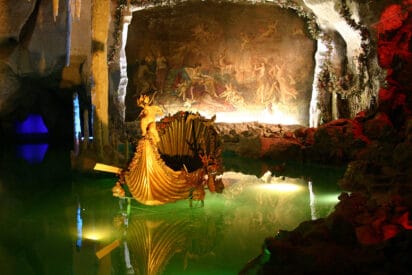
The most famous of the park buildings at Schloss Linderhof is the Venus Grotto (Venusgrotto). This artificial stalactite cave probably explains King Ludwig’s artistic vision, or quest for the perfect synthesis of the arts (Gesammtkunstwerk), better than any of his larger fairy-tale castles.
The Venus Grotto, at 90 m (295 ft) long and up to 14 m (46 ft) high, was the largest artificial cave constructed in the 19th century. It was erected in two years (1875-77), while the most recent restoration took a decade.
It was conceived as an immersive theatre stage, where Ludwig could escape to a different world without actually traveling. The main scene is Act I from Wagner’s Tannhäuser. A further highlight was inspired by the Blue Grotto on Capri, while most of the details of a Himalayan scene were lost. Electric lights were already installed in 1881, with colored glass panels allowing for different color schemes.
The entrance to the Venus Grotto is around 50 m (164 ft) higher than the palace. Allow for 15 minutes between tours of these two ticketed venues at Linderhof.
Visit Linderhof on Day Trips from Munich
Schloss Linderhof Palace is in the Ammer Valley near Oberammergau and the monastery town of Ettal. It is a popular day-trip destination from Munich and a great side trip from the popular Schloss Neuschwanstein Castle.
Linderhof and Neuschwanstein are easy to combine in a single day by car or organized tour. The drive between the two palaces takes less than an hour — also add the UNESCO-listed Rococo Wieskirche — it is only 5 minutes out of your way.
However, on public transportation, it is almost impossible to see both on the same day. Multiple bus changes are required, taking around 3 hours between Linderhof and Hohenschwangau. Better combinations are with Ettal (monastery and church — try a bus connection with a 30- to 45-minute changeover time in Ettal for a quick visit) and Oberammergau, where you are likely to change from bus to train.
→ See also Visit Schloss Linderhof: Opening Hours, Tickets, and Transportation for more details on visiting this impressive palace.
Visit King Ludwig’s Castles and Palaces near Munich
King Ludwig II’s three famous palaces are among Bavaria’s top attractions and popular day trips from Munich. Each offers a very different experience — from the fairy-tale towers of Neuschwanstein to the intimate luxury of Linderhof and the Versailles-inspired grandeur of Herrenchiemsee. Since their inscription as UNESCO World Heritage Sites in 2025, they have become even more popular day-trip destinations from Munich.
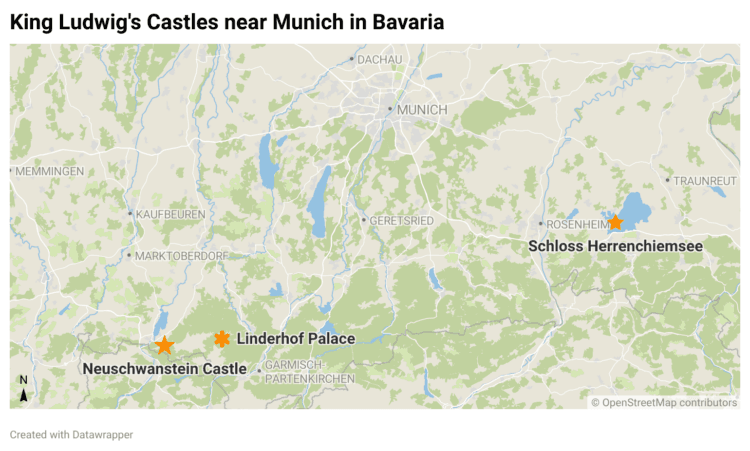
Use the guides below to choose which palace to visit, check tickets and transportation, or book a guided tour from Munich.
→ ⭐ Not sure which castle to visit? Compare King Ludwig’s three palaces here.
Plan Your Visit
- Which of King Ludwig’s Fantasy Castles Should You Visit Near Munich?
- Best Sightseeing Saving Passes in Munich and Bavaria
- Save with the Bayern Ticket on Public Transportation — Buy the Bayern Ticket Online.
- Book Day-Trip Tours from Munich
Schloss Neuschwanstein and Schloss Hohenschwangau
Fairy-tale castles near Füssen with timed-entry tickets that often sell out.
- Tickets for Neuschwanstein and Hohenschwangau
- Transportation to Schloss Neuschwanstein
- Why Visit Schloss Neuschwanstein?
- Why Visit Schloss Hohenschwangau?
- What to See in Nearby Füssen and Schwangau
- Neuschwanstein Day-Trip Tours
Linderhof Palace and Park
King Ludwig’s only completed palace, famous for its lavish interiors and landscaped gardens.
- Why Visit Schloss Linderhof?
- Linderhof Visitor Guide: Opening Hours, Tickets, and Transportation
- Day-Trip Tours to Linderhof
Schloss Herrenchiemsee
A Versailles-inspired palace on a peaceful island in Lake Chiemsee.
- Herrenchiemsee Visitor Guide: Sights, Opening Hours & Tickets
- Why Visit Schloss Herrenchiemsee?
- Transportation to Schloss Herrenchiemsee
- Book Day-Trips from Munich to Herrenchiemsee