The bust of Queen Nefertiti (Nofretete) is the top attraction of the Egyptian Collection in the Neues Museum on Museum Island in Berlin.
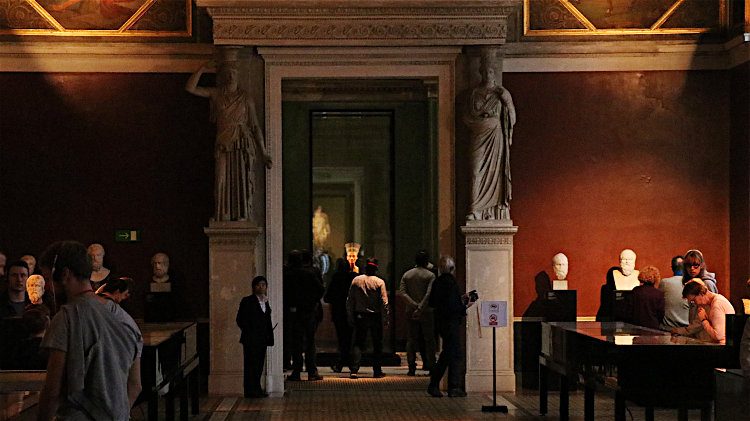
The Neues Museum is one of the most popular museums to visit in Berlin. Its top must-see item is the bust of Queen Nefertiti (Nofretete in German) –- one of the most famous artworks from Ancient Egypt. In addition to the Egyptian Museum and Papyrus Collection, the Neues Museum is also home to the Museum for Prehistory and Early History. Top attractions from these collections include the Celtic Golden Hat calendar, a Neanderthal skull, and items from Heinrich Schliemann’s excavation of Homer’s Troy. Buy tickets online with timeslot admissions or make free time reservations when using discount combination savings tickets.
Neues Museum in Berlin: Quick Guide
📍 Location: Museum Island (Museumsinsel), Berlin
⭐ Don’t Miss:
- Bust of Nefertiti
- Golden Hat calendar
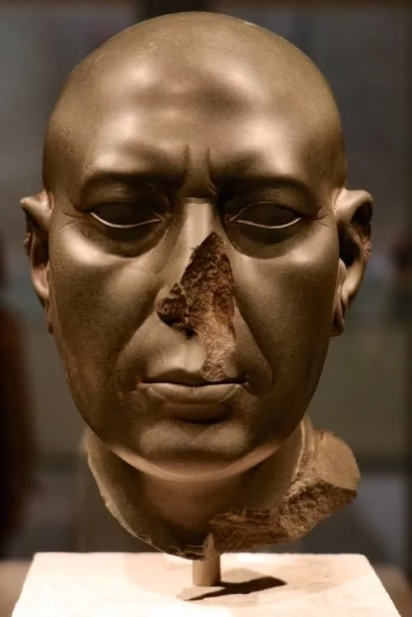
- Berlin Green Head
- Neanderthal skull
- Schliemann’s Troy
⏱ Time Needed:
- 1–2 hours for highlights
- 3+ hours for a thorough visit
🎟 Best Ticket:
Museum Island Day Ticket if visiting more than one museum
📅 Best Time to Visit:
Weekdays at 10:00 or after 15:00
👨👩👧👦 Good For:
Ancient Egypt, archaeology, and history museum enthusiasts
Jump to:
Top 6 · Nefertiti · Egypt · Golden Hat · Stone Age · Tickets · Hours
The Neues Museum on Museumsinsel Berlin
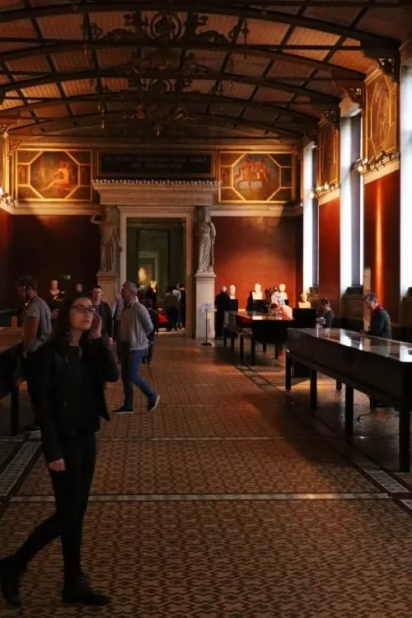
The Neues Museum on Museum Island in Berlin is one of the top museums in Germany, with the bust of Nefertiti for many the main reason to visit.
Neues Museum means New Museum. The name simply confirms that the museum building was built after the adjacent Altes Museum. The Neues Museum, originally finished in 1855, was heavily damaged during the Second World War. War damage mostly left the building unused until the late 20th century. A full restoration that deliberately left much of the war damage visible was completed only in 2009.
Somewhat ironically, the Neues Museum has the oldest items on display from the following collections of the Berlin State Museums:
- The Egyptian Museum and Papyrus Collection (Ägyptischen Museum und Papyrussammlung) includes items from ancient Egypt and Nubian cultures spanning four millennia. “Die Nofretete” is, of course, the main attraction.
- The Museum for Prehistory and Early History (Museum für Vor- und Frühgeschichte) covers six millennia of archaeological finds, mostly from Europe and the Near East, from the Stone Age to the early Middle Ages.
- A few items from the Classical Antiquities Collection (Antikensammlung), but most items from this vast collection are displayed in the Altes and Pergamon Museums.
Top Must-See Highlights in the Neues Museum in Berlin
The top six must-see attractions of the Neues Museum in Berlin are:
- Bust of Queen Nefertiti
- Thirty Centuries of Sculpture
- Golden Hat
- Stone Age Collection
- Treasures from the Rhine
- Schliemann’s Troy
The exhibitions are spread over four floors, but the top six items are:
- The Bust of Queen Nefertiti — one of the most famous artworks from Ancient Egypt. (Room 210)
- Thirty Centuries of Sculpture — a collection of Egyptian heads showing how art changed over three millennia. (Room 109)
- The Golden Hat — a Celtic calendar in the form of a ceremonial hat from around 1000 BC. (Room 305)
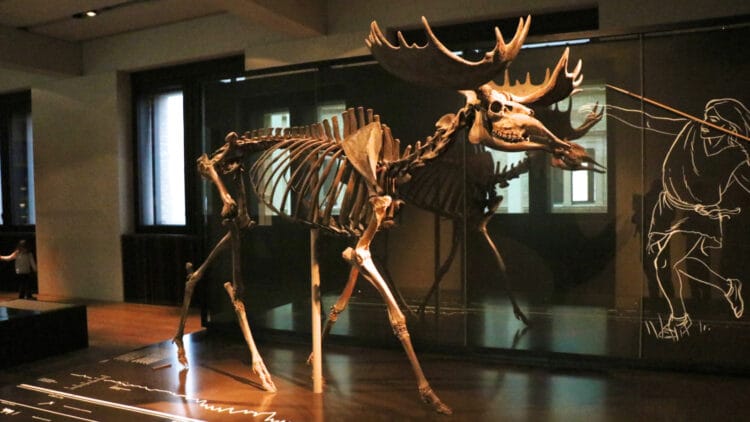
- The Stone Age Collection — including a Neanderthal skull and the skeleton of an elk found locally. (Room 308)
- Treasure from the Rhine — Roman art found in the Rhine River, including the Xantener Knabe statue. (Room 201)
- Schliemann’s Troy — mostly copies of the treasures Schliemann brought back from Homer’s Troy. (Rooms 103-4)
Top Visiting Tips for the Neues Museum and Nefertiti
The Neues Museum is too big to see everything in a single visit. Furthermore, it covers a fairly wide spectrum of themes, making it sensible to focus on specific areas or top items on a first visit.
The average visitor spends one to two hours at the Neues Museum. A simple walk through the museum’s four floors already requires about 90 minutes. Spending three hours or half a day here is easy — museum fatigue will set in long before you run out of displays.
Seeing just Nefertiti and the main Egyptian Museum can probably be done in a rushed 45 minutes. (Many groups do just this, leaving many other exhibition halls pleasantly quiet.)
Top Tip: Spend 10 to 15 minutes studying the explanation of the workings of the Golden Hat. The knowledge gained will elevate the Goldhut from a silly Stone Age curiosity to a major cultural object of human achievement.
The best time to visit the Neues Museum is first thing in the morning or after 15:00 on weekdays. If avoiding weekends is impossible, try to enter between 11:30 and 13:00.
The Egyptian Museum and Papyrus Collection in Berlin
The Egyptian Museum and Papyrus Collection is spread over three floors of the Neues Museum in Berlin:
The bust of Nefertiti is on the second level, as are a variety of other sculptures from Ancient Egypt and the large papyrus collection. The papyri are displayed in glass cabinets in a darkened room with different items sliding out on demand.
On the ground floor is the Dreißig Jahrhunderte (30 Centuries) collection of head sculptures (Room 109) showing how art and the depiction of people developed in ancient Egypt over a period of 3,000 years. These heads included not only pharaohs and priests but also other, less important figures. The best-known statue – the Berlin Green Head – is of an unknown person made around 350 BC.
In the cellar are further small displays covering death and life after death. The number of mummies on display is surprisingly small for an Egyptian museum, with the animal mummies probably the most interesting.
The Bust of Queen Nefertiti in Berlin
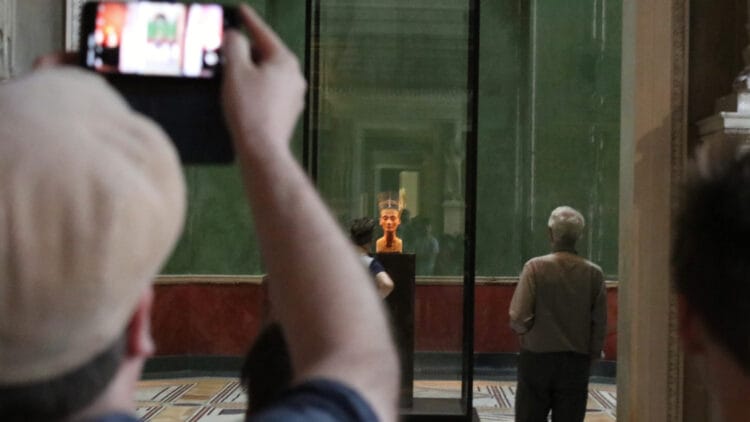
The bust of Nefertiti (Die Büste der Nofretete) in Room 210 is the undisputed highlight of the Neues Museum and one of the most famous single items of Egyptian art in the world. It dates from the period around 1351 – 1334 BC and came to Germany shortly before the First World War.
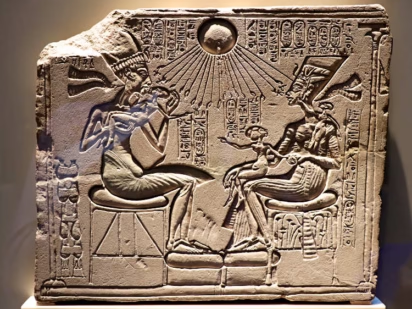
Born a commoner, Nefertiti married pharaoh Akhenaton (Echnaton), and thanks to this statue is, after Cleopatra, the most famous Egyptian queen ever. Slightly irritating to many Egyptologists, this statue is not particularly representative of Egypt or the period. Other depictions of Nefertiti and the royal family on display in the museum are more typical (but less popular).
The Bust of Nefertiti is nearly half a meter tall and made of sandstone with painted stucco layers. The overall condition of the sculpture and the paint color are remarkably good and show amazing details, including wrinkles around the eyes.
Photography is not allowed in the room where Die Nofretete is on display. As this prohibition is actively enforced, crowds move on fairly fast, making it easy to study the statue close up in more detail and fully appreciate its timeless beauty.
Follow the room numbers of the second floor — a one-way system is used and often enforced at room 210. You may return to Nefertiti as many times as you want, but it is a long way round.
[Somewhat surprisingly, one of the best Ancient Egyptian collections in Germany is not in a major city. The Roemer-Pelizaeus Museum has one of the four best collections in the world on the Old Kingdom. It is in the small city of Hildesheim (near Hannover), which is more famous for its UNESCO-listed Romanesque churches and large half-timbered buildings.]
The Museum of Prehistory and Early History in Berlin
The Museum of Prehistory and Early History uses the largest part of the Neues Museum in Berlin. Unfortunately, many items are copies, as around 10,000 items confiscated after the Second World War are still on display, or in storage, in various museums in Russia. However, the copies (Nachbildungen) mostly made before the Second World War are good, and enough original items are on display to make for a very interesting visit.
→ On the top floor (3rd), follow the room numbers in reverse order for the recommended chronological route.
The Stone Ages in the Neues Museum

The Stone Age (Steinzeit) collection is on the top floor of the museum. The displays include the usual collection of archaeological finds and bones, with the following two items of particular interest:
- The largely intact skull with a full set of teeth of an 11-year-old male Neanderthal (Homo mousteriensis Hauseri) was discovered at Le Moustier in France. It dates from around 45,000 BC. Modern scientific technology made it possible to make a bust of what the boy probably looked like.
- The Elch vom Hansaplatz — the full skeleton of a moose from around 10,700 BC was discovered in Berlin in 1956 during the construction of the local U-Bahn.
The Golden Hat and the Bronze Age in the Neues Museum
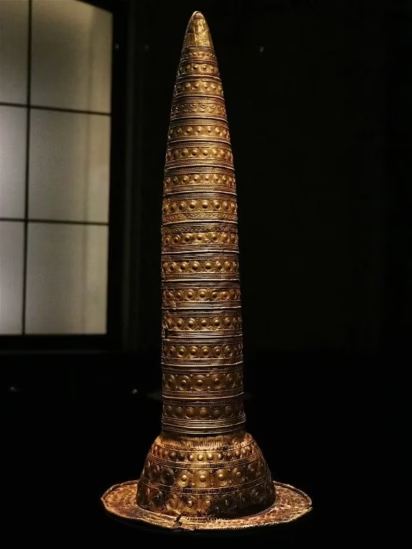
The Golden Hat (Berliner Goldhut) in room 305 is one of the highlights of the Neues Museum and the Staatliche Museen zu Berlin collections.
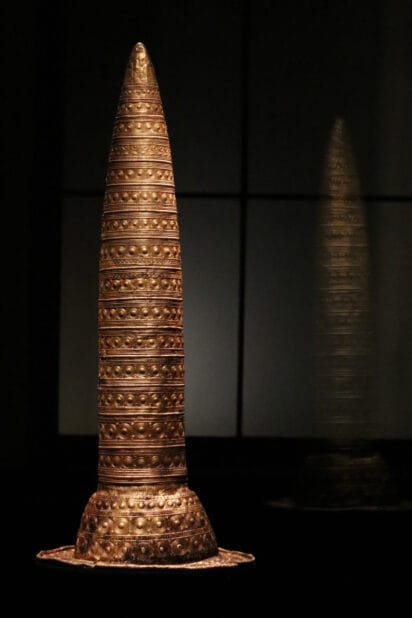
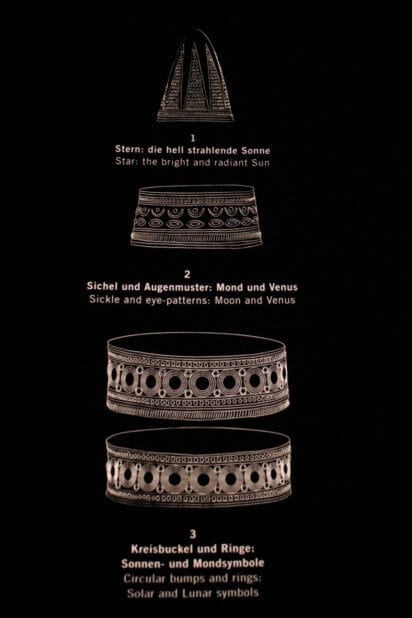
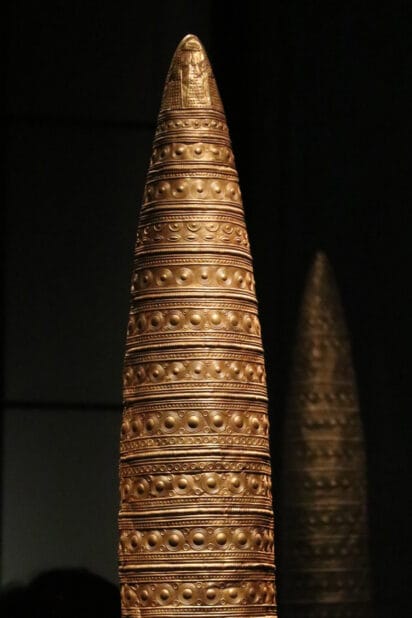
This 74-cm-high ceremonial hat (29″) from southern Germany was hammered without a seam from a single piece of gold leaf during the late Bronze Age (1000 – 800 BC). At least 20 further instruments were used to apply the decorations.
The Golden Hat is not only pretty to look at but had a practical use as a very advanced calendar.
It is displayed in its own room with detailed explanations of how the celestial symbols on 21 horizontal bands may be used to determine the calendar through either the 365-day sun year or the 12 lunar cycles of 354 days. The calculations allowed for leap years, too.
Spend the 10 – 15 minutes required to study the workings to elevate this Stone Age curiosity to a magnificent cultural and scientific object of human achievement.
A similar golden hat is on display in the Germanisches Nationalmuseum in Nuremberg.
In the adjacent room, press the button to hear the lurs playing. (Only copies are on display; the originals are still in Russia.)
Treasures from the Rhine in the Neues Museum

The second level of the museum has several exhibitions on the Romans and especially the Roman provinces that included the southern and western parts of modern-day Germany. Cities such as Trier, Cologne, and Mainz were major Roman settlements.
A highlight here is the Treasures from the Rhine (Schätze aus dem Rhein) – a large collection of Roman items that were presumably sunk in the Rhine by “barbarians” in the third century. Most items are typical items used in Roman private houses.
A top attraction is the Xantener Knabe (Boy of Xanten or Xanten Youth) – a largely intact life-size bronze sculpture from the first century AD that was also recovered from the Rhine. The youth is missing only his right forearm (and the tray he was probably carrying).
Larger exhibitions of Berlin’s Antiquities Collection are in the Pergamon and Altes Museums.
Schliemann’s Troy in the Neues Museum
Heinrich Schliemann (1822-1890) was one of the most famous German amateur archaeologists ever. He famously excavated Troy with more enthusiasm than scientific methods or patience. Although later archaeologists accused him of wanton destruction of much of historic Troy, he did bring some fantastic treasures back to Germany and sparked much interest in archaeology in general.
Schliemann’s Troy used to be one of the top attractions of Berlin’s historical collection, but most items were transported to the Soviet Union in 1945 and never returned. Good copies, and a few original items, are on display in a small exhibition on the ground floor of the Neues Museum.
Where Are Antiquities Exhibited in Berlin
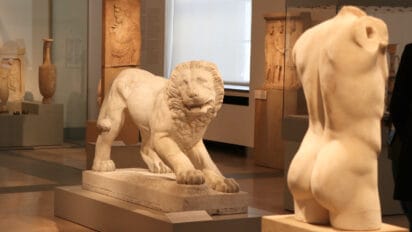
To see Berlin’s popular Antikensammlung (Collection of Antiquities), you’re best off buying a Museum Insel ticket or more.
This impressive collection is spread through three museums: the Altes Museum, Neues Museum, and Pergamon Museum. Further temporary exhibitions are in the James Simon Gallery.
What antiquities are seen in which Berlin Museum? The answer is not that easy, but use the following as a rough guide:
- Archaeological finds from the Stone Age to the Middle Ages and items from the Roman provinces are in the Neues Museum (together with the large Egyptian collection).
- The bigger, the more likely it is in the Pergamon Museum.
- The more classical the civilization, the more likely you’ll see it in the Altes Museum. (Classic Greek, Etruscan, Roman sculptures and pottery.)
- See also Berlin State Museum Collections Explained: What is Seen Where? for a fuller guide to Berlin’s vast museum exhibitions and magnificent art galleries.
Neues Museum Berlin Visitor Information
Buying Tickets for the Neues Museum in Berlin
Admission tickets for the Neues Museum are €14 and free for children up to 18 years old. An excellent free audio guide is included.
For most visitors, buying a ticket online is the easiest option and avoids ticket office queues. If planning to visit another venue on the same day, a Museum Island day ticket or three-day passes offer better value.
It is still possible to buy tickets at the Simon James Gallery, the new main entrance in the basement of the Neues Museum (and Pergamonmuseum). Visitors with scanable tickets may usually still use the two ground-floor entrances.
A variety of combination discount savings tickets for the Neues Museum are available:
- €24,00 – Museum Island Day Ticket: admission to all SMB museums on Museum Island for a calendar day.
- €32 – Museum Pass Berlin: unlimited admission to over 30 top museums in Berlin on three consecutive days, including the Neues Museum and all Museum Island museums.
- €62 – Berlin Welcome Card 72h + Museum Island: gives all the transportation and savings advantages of the regular Welcome Card plus free admission to the Museum Island museums. (Note: the regular Berlin Welcome Card does not give admission or any discounts for the Neues, Pergamon, or any other of the Berlin State Museums.)
- €25 to €120 – Annual Membership Passes: admission for a year to all 19 Staatliche Museen zu Berlin museums. Can be a very good deal for longer or multiple visits.
None of these savings passes, except the €120 annual membership pass, are skip-the-line tickets. Go directly to the entrance, but if there is a queue, you have to wait too.
TIP: Always make free time-slot reservations online if the option is offered — currently only possible for major exhibitions.
Opening Hours for the Neues Museum in Berlin

The Neues Museum is open Tuesday to Sunday from 10:00 to 18:00.
The Neues Museum is open on most vacation days but not on December 24 and 31, with shorter hours on January 1.
TIP: The Neues Museum is generally busiest in the mornings and all day on weekends. The best times to visit are right at opening time or after 15:00. If you have to visit on weekends, the best times to enter the museum are between 11:30 and 13:00.
Transportation to the Neues Museum

The Neues Museum, Bodestraße 1-3, 10178 Berlin, is on Museum Island in Mitte in the heart of Berlin.
Admission is currently possible either at ground level or via the basement and the modern James-Simon-Galerie, which is used for temporary exhibitions.
The most convenient U-Bahn stop is U-5 Museumsinsel. Buses 100 and 300 also stop here at U Museumsinsel (previously, Lustgarten stop).
More on the Berlin State Museums (Staatliche Museen zu Berlin):
Berlin State Museum Basics:
- Top National Museums and Galleries (brief overview)
- Berlin State Museums: What Is Seen Where?
- Opening Hours (2026)
- News & Special Exhibitions
- Ticket Prices (Buy online from GetYourGuide or SMB)
- Save with the Berlin Museum Pass & Berlin Welcome Cards
- Staatliche Museen zu Berlin (official website in German & English)