Füssen in Bavaria is an excellent base for visiting Schwangau (Neuschwanstein and Hohenschwangau Castles) as well as nearby Linderhof Palace, Wieskirche, Ettal Abbey, and Oberammergau. Hotels are often cheaper than in Munich, while the attractive old town has several worthwhile historic sights of its own.

Füssen is in the beautiful Allgäu region of Bavaria, a very popular holiday destination in Germany. Vacationers enjoy the numerous outdoor activities, but the streams of day-trippers from Munich (München) come mostly to see the Disney-like Schloss Neuschwanstein and nearby Hohenschwangau castles. Most travelers transit via Füssen, the final stop of the Romantic Road, when traveling to Neuschwanstein by train from Munich. Füssen is also a pleasant town to sleep in, with hotels generally cheaper than in cities, making it easier to book an early morning castle tour of Neuschwanstein.
Top Sights to See in Schwangau
Schloss Neuschwanstein Castle, one of Germany’s most visited attractions, is undoubtedly the most popular destination in the Schwangau region and a must-see sight for many travelers to Germany. This white castle, with its medieval, neo-Romanesque look, was built in the late nineteenth century by Bavarian “Mad” King Ludwig II. Ticket reservations to see the interior are highly advisable.
Nearby Schloss Hohenschwangau is an early 19th-century, neo-Gothic castle. King Ludwig spent much of his childhood here, and the romantic setting inspired his own building spree. Hohenschwangau Castle is generally easier to visit than Neuschwanstein, although advance reservations are still recommended during busy periods.
Great short hikes near Schwangau include the wild-romantic Pöllatschlucht (Pöllat Gorge) near Schloss Neuschwanstein and a walk to the Marienbrücke (Mary Bridge) for the indisputably best views of the castle. Many further and longer walks are available in the mountains above Schwangau.
Top Sights in Füssen – Final Stop on Germany’s Romantic Road
Most travelers using public transportation to Schloss Neuschwanstein change from the train to the local bus in Füssen. Few venture into this small old town, which has several interesting buildings that are actually medieval rather than 19th-century fantasies, such as Neuschwanstein and Hohenschwangau. Füssen is the official last stop on the popular Romantic Road (Romantische Straße) vacation route that connects many romantic sights in Bavaria.
- The Hohe Schloss (High Castle) in Füssen houses Gothic paintings from the Bayerische Staatsgemäldesammlung (Bavarian State Gallery) and the Städtische Gemäldegalerie (Municipal Gallery). In contrast to Hohenschwangau Castle, the Hohe Schloss in Füssen is real Late Gothic from the 15th century. Parts of the castle are even two hundred years older.
- Kloster St Mang (Monastery), a large former monastery, is probably the most impressive sight in Füssen. The monastery is mostly 18th-century Baroque. The crypt of the Klosterkirche (Abbey Church) in Füssen has the oldest wall paintings in Bavaria (dating from around AD 1000).
- The Franziskanerkloster in Füssen is a former Franciscan Monastery. In the monastery garden is the official end of the Romantic Road – a sign is available for photographic proof of a visit. However, the main reason to visit is the fine views that can be enjoyed from the monastery of the old town, castle, and monastery.
The old town center of Füssen is a few blocks from the train station. Reichenstrasse is the main shopping street with the largest patrician buildings.
Popular Sights near Füssen and Schwangau, Germany
In addition to the fantasy castles in Schwangau and the old town of Füssen, several further sights are within easy driving distance from Füssen. Most sights can be reached by public transportation, but double-check return times as some buses offer limited services on weekends and during school holidays.
- Die UNESCO World Heritage-listed Wieskirche (Church in the Meadow) is a definitive work of the Bavarian Rococo.
- Oberammergau has many Luftmalerei (tromp d’oeil) painted building façades and is famous for the Passion Play performed every decade. The next Obergammergauer Passionspiele performance is in 2030.
- Ettal’s Baroque abbey church has an unusual figure-eight floor plan in Germany.
- King Ludwig’s Schloss Linderhof Palace, in a large park in the Ammer Valley, is small but richly decorated. In contrast to the more popular Schloss Neuschwanstein, Linderhof can be seen without reservations or long queues.
The Füssen-Schwangau area is mostly visited by day-trippers from Munich going to visit Schloss Neuschwanstein. Transportation is easy by rail and bus from Munich, although having a car makes it much easier to combine several attractions in a single day.
Visit King Ludwig’s Castles and Palaces near Munich
King Ludwig II’s three famous palaces are among Bavaria’s top attractions and popular day trips from Munich. Each offers a very different experience — from the fairy-tale towers of Neuschwanstein to the intimate luxury of Linderhof and the Versailles-inspired grandeur of Herrenchiemsee. Since their inscription as UNESCO World Heritage Sites in 2025, they have become even more popular day-trip destinations from Munich.
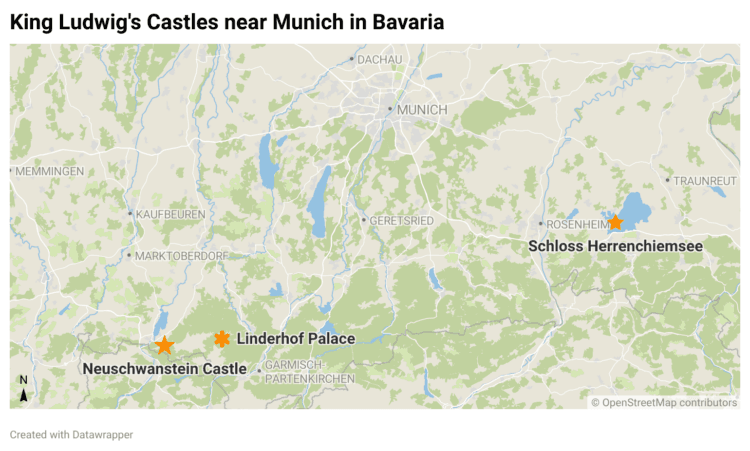
Use the guides below to choose which palace to visit, check tickets and transportation, or book a guided tour from Munich.
→ ⭐ Not sure which castle to visit? Compare King Ludwig’s three palaces here.
Plan Your Visit
- Which of King Ludwig’s Fantasy Castles Should You Visit Near Munich?
- Best Sightseeing Saving Passes in Munich and Bavaria
- Save with the Bayern Ticket on Public Transportation — Buy the Bayern Ticket Online.
- Book Day-Trip Tours from Munich
Schloss Neuschwanstein and Schloss Hohenschwangau
Fairy-tale castles near Füssen with timed-entry tickets that often sell out.
- Tickets for Neuschwanstein and Hohenschwangau
- Transportation to Schloss Neuschwanstein
- Why Visit Schloss Neuschwanstein?
- Why Visit Schloss Hohenschwangau?
- What to See in Nearby Füssen and Schwangau
- Neuschwanstein Day-Trip Tours
Linderhof Palace and Park
King Ludwig’s only completed palace, famous for its lavish interiors and landscaped gardens.
- Why Visit Schloss Linderhof?
- Linderhof Visitor Guide: Opening Hours, Tickets, and Transportation
- Day-Trip Tours to Linderhof
Schloss Herrenchiemsee
A Versailles-inspired palace on a peaceful island in Lake Chiemsee.
- Herrenchiemsee Visitor Guide: Sights, Opening Hours & Tickets
- Why Visit Schloss Herrenchiemsee?
- Transportation to Schloss Herrenchiemsee
- Book Day-Trips from Munich to Herrenchiemsee